
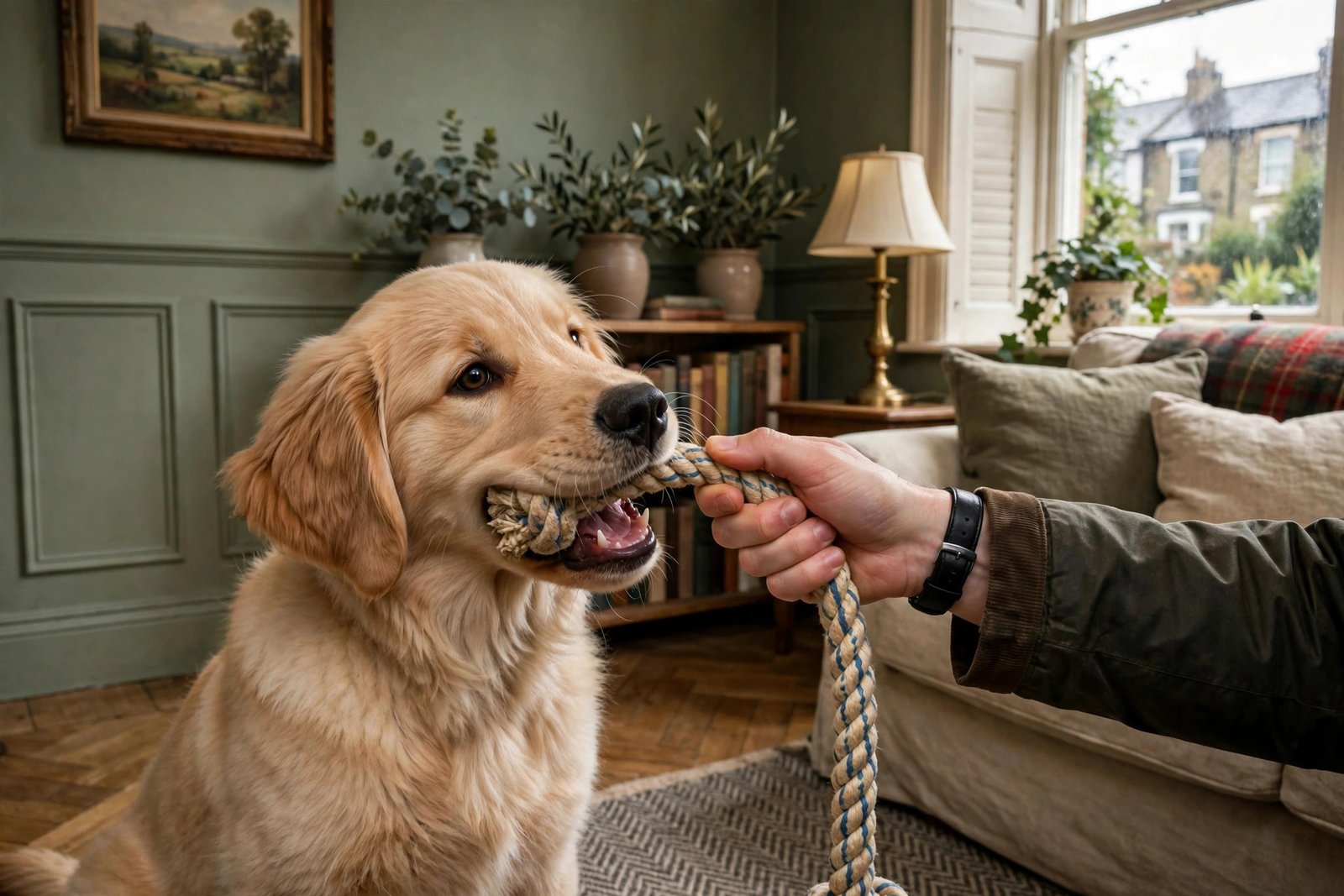
Those needle-sharp puppy teeth are a developmental marvel and a household menace. Every new puppy owner in Britain goes through the same phase: the adorable eight-week-old becomes a tiny land shark, and your hands, ankles, sleeves and furniture bear the evidence. Here’s the reassuring news: puppy biting is completely normal, it peaks and passes, and with consistent handling you can guide your puppy through it without anyone losing patience — or skin.
Why puppies bite: it’s not aggression
First, reframe what’s happening. Puppies explore the world with their mouths the way babies do with their hands. Biting is how they play with littermates, how they learn bite inhibition (how hard is too hard), and how they soothe the discomfort of teething — which runs from about 12 weeks to 6–7 months as 28 baby teeth are replaced by 42 adult ones. A biting puppy is not an aggressive puppy; they’re a baby doing baby things. Treating it as aggression (shouting, punishment, alpha-rolling) is both ineffective and damaging — it teaches fear, not manners.
The core technique: teach bite inhibition
In the litter, puppies learn bite inhibition from each other: bite too hard, the sibling yelps and stops playing. You replicate this:
- When the puppy bites too hard, yelp or say “ouch” in a calm, slightly high-pitched voice — then immediately stop all interaction for 10–20 seconds. Turn away, fold your arms, become boring.
- Resume play calmly. If they bite hard again, repeat. Three strikes and the play session ends entirely — calmly put them in their pen or another room for a brief reset.
- Reward gentle mouthing. When the puppy mouths softly or licks instead of biting, praise warmly. You’re shaping the behaviour you want, not just punishing what you don’t.
Consistency across the whole household is non-negotiable. If one family member wrestles roughly while another yelps at nips, the puppy gets contradictory data and learns nothing. Hold a five-minute family meeting and agree the rules: everyone responds identically, every time. The Kennel Club’s puppy training resources reinforce these positive methods as the UK standard.
Redirect, don’t just correct
“No” alone teaches the puppy what not to do; redirection teaches what to do instead. Keep suitable chew toys within arm’s reach in every room. The moment teeth head for your hand, swap in the toy with enthusiasm — “oh, you want to chew? Here’s the thing for chewing!” Praise the toy-chewing lavishly. Over weeks, the puppy learns the simple rule: toys are for biting, people are for gentle interaction. Frozen carrots, frozen damp tea towels (supervised), and rubber toys stuffed with food all give teething puppies appropriate outlets for the very real physical need to chew.
Manage the environment: set the puppy up to succeed
Training works best when the puppy isn’t constantly rehearsing the unwanted behaviour:
- Enforce naps. An overtired puppy is a bitey puppy — wildly so. Puppies need 18–20 hours of sleep a day. If your puppy turns into a demon at 7pm, they’re not badly behaved; they’re exhausted. Crate or pen them for enforced rest.
- Don’t use hands as toys. Wrestling with hands teaches that hands are chew objects. Use toys for all rough play, always.
- Manage excitement levels. Wild, high-pitched play escalates biting. Keep play sessions short and calm-ish, ending before the puppy gets over-aroused.
- Exercise the brain. A mentally tired puppy bites less. Short training sessions, sniff walks (letting them sniff everything — it’s tiring), and food puzzles drain the energy that becomes biting.
Setting boundaries calmly is a transferable skill — the same consistent, patient approach that works for setting boundaries with family members works with puppies: clear, kind, and utterly consistent.
The biting timeline: what to expect month by month
It helps to know the arc. At 8–10 weeks, biting is exploratory and relatively gentle — the puppy is discovering their mouth. At 10–16 weeks, it peaks: teething begins, the puppy has more energy and confidence, and this is when most owners despair. From 4–6 months, adult teeth come in (you’ll find tiny teeth on the carpet — completely normal), and biting gradually shifts from constant to situational, usually tied to excitement or tiredness. By 7–9 months, most puppies mouth only when over-aroused, and with consistent training the habit fades to occasional gentle mouthing. If you’re in the thick of the peak weeks, remember: you’re not failing, and your puppy isn’t broken. You’re in the hardest fortnight of a process that resolves.
What NOT to do
It’s worth pausing on the don’ts, because bad advice about puppy biting is everywhere — from well-meaning relatives to old training books that haven’t caught up with modern behavioural science:
- Don’t smack, scruff or “alpha roll”. Physical punishment teaches the puppy that hands are scary, which can create genuine aggression later — the opposite of what you want.
- Don’t hold the muzzle shut. It doesn’t teach anything except that you’re unpredictable.
- Don’t use bitter sprays as your main strategy. They deter some puppies but don’t teach anything; use them as a supplement at most.
- Don’t expect overnight results. Biting typically peaks at 10–16 weeks and fades significantly by 6–7 months as teething ends. You’re managing a developmental stage, not fixing a defect.
When biting might be something more
Normal puppy biting is inhibited (they’re learning to be gentle), happens during play or excitement, and the puppy is otherwise friendly and relaxed. Seek professional help from a qualified behaviourist (look for APBC or ABTC registration in the UK) if: the biting is hard and uninhibited with no improvement over weeks, the puppy stiffens, growls or guards resources, biting is directed at faces with intent, or anyone in the household is frightened. True aggression in young puppies is rare, but early professional intervention is effective — don’t wait and hope.
Puppy classes are also invaluable — not just for training, but for socialisation. A well-socialised puppy who plays appropriately with other dogs learns bite inhibition faster than any human can teach it. Look for classes run by qualified trainers using positive methods; the RSPCA’s guidance on choosing a trainer is a solid starting point. And remember that managing persistent behaviours patiently — whether it’s a mouthy puppy or setting limits on kids’ habits — follows the same principles: consistency, redirection and calm.
Conclusion
Training a puppy to stop biting comes down to three things: teaching bite inhibition through the yelp-and-withdraw method, redirecting chewing onto appropriate toys, and managing the environment (especially sleep) so the puppy isn’t set up to fail. Stay consistent across the household, never use punishment, and remember the timeline — this is a developmental stage that peaks around 3–4 months and fades as teething ends. The land shark phase feels endless when you’re living it, but it does end, and the gentle-mouthed adult dog on the other side is worth every chewed slipper.
Frequently Asked Questions
At what age do puppies stop biting?
Biting typically peaks at 10–16 weeks and reduces significantly by 6–7 months as teething finishes. Consistent training throughout this period produces a gentle-mouthed adult.
Should I punish my puppy for biting?
No. Punishment (smacking, scruffing, alpha rolls) creates fear and can cause genuine aggression. Positive methods — yelping, withdrawing attention, redirecting to toys — are more effective and recommended by UK behaviourists.
Why does my puppy bite more in the evening?
Overtiredness. Puppies need 18–20 hours of sleep daily, and the evening “witching hour” zoomies-and-biting session is a classic sign of an exhausted puppy. Enforce a nap instead of engaging.
When should I worry that puppy biting is aggression?
If bites are hard and uninhibited with no improvement, the puppy stiffens or growls, guards resources, or anyone is frightened — consult an APBC/ABTC-registered behaviourist promptly. True aggression is rare but needs early professional help.

Leave a Reply