
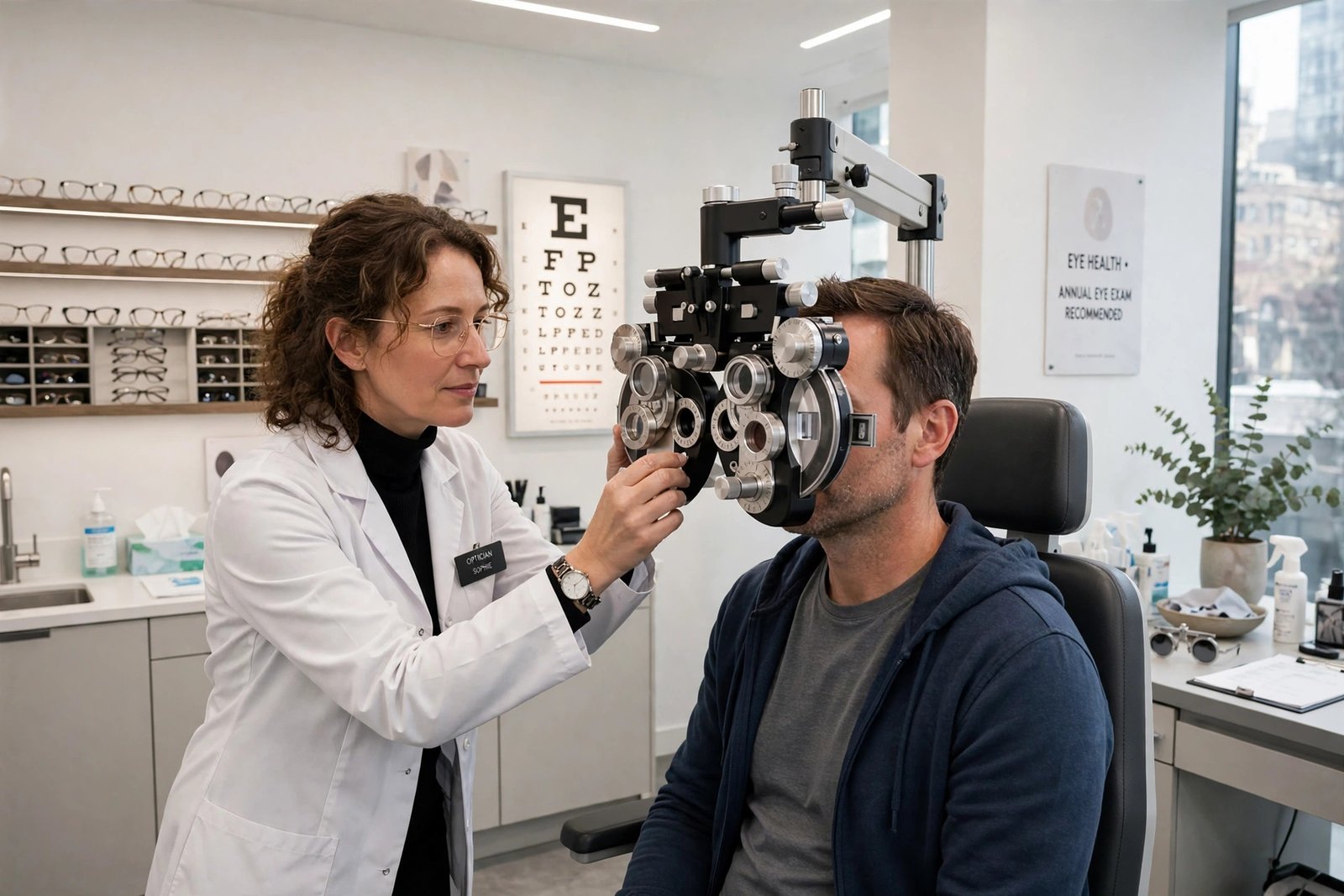
When did you last have an eye test? If you’re squinting to remember, you’re in the majority — most Brits leave it far too long. Eye tests aren’t just about whether you need glasses; they’re one of the few health checks that can spot serious conditions years before symptoms appear. So how often should you get your eyes tested? The answer depends on your age, your eyes, and your risk factors — but “every couple of years” is the baseline almost everyone should know. So, How often should I get my eyes tested? Here’s what actually works.
How Often should I Get My Eyes Tested — The standard guidance
The College of Optometrists and NHS guidance converge on a simple schedule:
- Under 16: every year (children’s vision changes fast, and undetected problems affect learning).
- 16–69, no issues: every two years. This is the default adult recommendation.
- 70 and over: every year. Risk of glaucoma, cataracts and macular degeneration climbs steeply.
- Higher risk groups: every year, or as your optician advises. This includes people with diabetes, a family history of glaucoma, very short-sightedness (high myopia), or those already under treatment for an eye condition.
Your optician may recommend a different interval based on what they find — follow their advice over the generic schedule. And if you notice changes between tests (vision blurring, new floaters, eye pain), don’t wait for the next due date. Book.
Why it matters beyond glasses
Here’s what many people don’t realise: a routine eye test is a health screening, not a vision check. Your optician examines the back of your eye, where blood vessels and the optic nerve are directly visible — the only place in the body you can see live blood vessels without cutting anything open. This means eye tests can detect:
- Glaucoma — the “silent thief of sight.” It damages the optic nerve with no early symptoms; by the time you notice vision loss, it’s permanent. Regular tests catch it when treatment can still save your sight. Family history makes this especially important.
- Diabetic eye disease — diabetes damages retinal blood vessels, often silently. (People with diabetes also get separate annual diabetic eye screening.)
- Cataracts and macular degeneration — age-related, gradual, and much better managed when caught early.
- High blood pressure and high cholesterol — sometimes first spotted in the retinal vessels during a routine test.
- Brain tumours and neurological issues — rarely, but changes in the optic nerve can be the first clue.
That’s a remarkable amount of medicine for a 30-minute appointment that often costs less than a takeaway — or nothing at all (see below).
Who gets free eye tests?
More people than claim them. You’re entitled to a free NHS eye test if you’re: under 16 (or 16–18 in full-time education); 60 or over; diagnosed with diabetes or glaucoma; at risk of glaucoma as advised by an ophthalmologist; prescribed complex lenses; or receiving certain benefits (Income Support, income-based JSA/ESA, Pension Credit Guarantee Credit, or holding an NHS tax credit exemption or HC2 certificate). Many people eligible for free tests don’t realise it — check before you pay.
If you need glasses, you may also qualify for an NHS optical voucher towards the cost. And even paying privately, a standard test typically runs £20–£30 at high-street opticians — with regular special offers making it effectively free.
What actually happens at the test
If you’ve been avoiding it from vague anxiety, here’s the reality: it’s painless and a bit boring. The optician checks your vision with the letter chart, tests your eye muscles and focussing, measures eye pressure (the famous “puff of air” — mildly startling, not painful; many practices now use gentler methods), examines the front of your eye with a microscope, and looks at the retina and optic nerve with drops or imaging. Some practices offer OCT scans (detailed 3D imaging of the retina) for an extra fee — worth considering over 40, as it detects early macular changes standard examination can miss.
Allow 30–45 minutes. If you wear contacts, the optician may ask you to remove them beforehand. Bring your current glasses, a list of medications, and details of any family eye history.
Between tests: watch for these
Don’t wait two years if you notice: sudden vision changes in one or both eyes; new showers of floaters or flashing lights (possible retinal detachment — urgent); eye pain; double vision; a shadow or curtain across vision; or increasing difficulty with night driving. These warrant prompt assessment, not patience. And if you’re in the reading-glasses stage of life or dealing with persistent dry eyes, mention it at your test — both are easily assessed and managed.
Children’s eye tests: what parents should know
Adult eye tests get the attention, but children’s vision deserves its own section — because undetected vision problems in children affect learning, behaviour and development, and children rarely complain (they assume everyone sees the way they do).
When to start. Children should have their first eye test around age 4–5 (before starting school), then every year through childhood. All children’s eye tests are free on the NHS — there’s no reason to wait. If there’s a family history of squint, lazy eye or strong prescriptions, mention it; earlier testing may be advised.
Signs your child might need a test sooner. Sitting very close to the TV or holding books close, squinting or screwing up eyes, frequent headaches (especially after school), rubbing eyes a lot, clumsiness or poor hand-eye coordination, avoiding reading or close work, or a teacher mentioning concentration issues. Any of these warrants a prompt test — they’re often vision, not behaviour.
Common childhood conditions. Lazy eye (amblyopia) — reduced vision in one eye because the brain favours the other; highly treatable if caught early (usually with patching), much harder after age 7–8. This is the big reason early testing matters. Squint (strabismus) — eyes not aligning; also best treated young. Short-sightedness (myopia) — increasingly common, linked to less outdoor time and more near work; special myopia-management lenses and drops can now slow progression. Long-sightedness — common in young children and often resolves, but significant cases need glasses to prevent lazy eye.
Screen time and children’s eyes. The evidence doesn’t show screens damage children’s eyes, but heavy near-work (screens, books) is associated with myopia development — while outdoor time is protective (bright daylight seems to be the key factor). The practical advice: encourage 1–2 hours of outdoor time daily, enforce the 20-20-20 rule for screens, ensure good lighting for homework, and get the annual test. Don’t panic about screens; do prioritise outdoors.
Glasses for children. If prescribed, the NHS provides free glasses for under-16s via optical vouchers — decent ranges are fully covered, with upgrades available. Let children choose frames they like (they’ll wear them); consider flexible, durable frames for younger kids and a sports strap for active ones. The stigma around children’s glasses has largely faded — many kids now consider them cool, which is a genuine cultural win.
The practical takeaway
Get your eyes tested every two years as an adult (yearly over 70, or with risk factors like diabetes or family glaucoma). It’s not just about glasses — it’s a painless screening that catches glaucoma, diabetic eye disease and even blood pressure issues before symptoms appear. Check if you’re entitled to a free NHS test, book the appointment you’ve been postponing, and consider an OCT scan after 40. Your future self will thank you.

Leave a Reply