
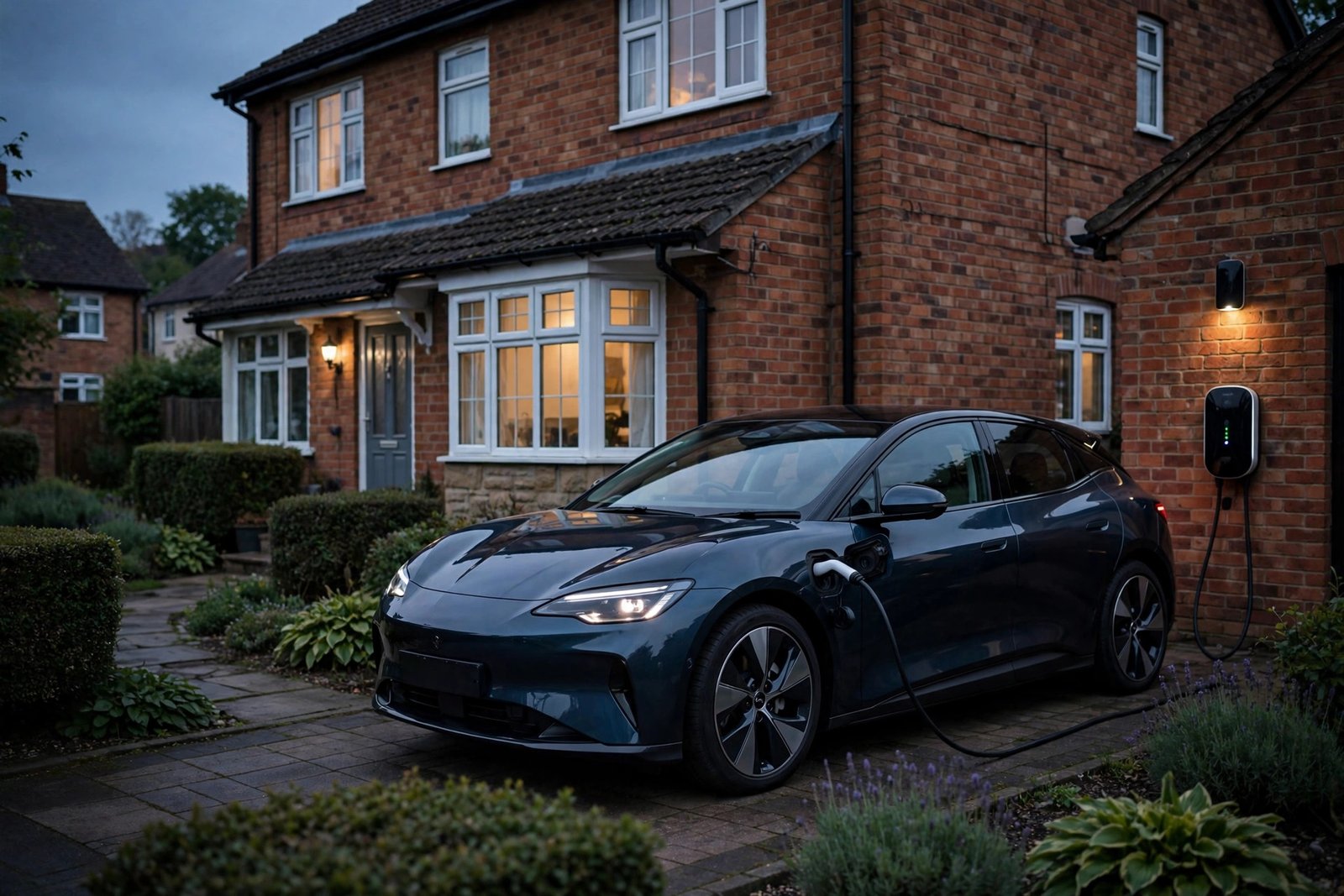
Electric cars have gone from curiosity to commonplace on British roads in barely a decade. You see them everywhere now: silently pulling away from traffic lights in Manchester, plugged in outside terraced houses in Bristol, queuing at motorway service stations. But “everyone’s getting one” isn’t an answer to the real question: is an electric car actually practical for the way you drive in the UK? Let’s work through it honestly — the genuine wins, the real compromises, and who should and shouldn’t switch in 2026.
The range question: how far do you actually drive?
Range anxiety is the first objection everyone raises, so let’s start with data. The average UK car journey is under 10 miles, and the average annual mileage is around 7,000–8,000 miles — roughly 20 miles a day.
The honest caveat: advertised WLTP range figures are optimistic. Expect 15–25% less in real British conditions — cold weather, rain, motorway speeds and heating all eat range. A car rated at 300 miles will do about 230–250 in a January motorway run. For most people that’s still plenty. It only becomes a problem if you regularly drive 200+ miles in a day without stopping — sales reps covering the country, for instance — or if you can’t charge conveniently (more on that below).
Charging: the make-or-break factor
Here’s the truth the EV evangelists sometimes gloss over: an electric car is transformationally practical if you can charge at home, and merely workable if you can’t. With a home charger (installation typically £800–£1,200, sometimes subsidised), you plug in overnight and wake up to a “full tank” every morning, at roughly 7–10p per kWh on an off-peak EV tariff. That’s about £8–£12 for 250 miles — versus £35–£45 in petrol for the equivalent. The fuel saving alone can be £1,000+ a year for average mileage.
Without home charging — and around a third of UK households have no driveway or garage — the picture changes. You’re dependent on public chargers, which cost 50–80p per kWh at rapid chargers: still cheaper than petrol per mile, but the convenience gap narrows and the savings shrink. The public network has improved enormously, with tens of thousands of chargers now live, and the government’s charging infrastructure strategy continues to expand it — but coverage is patchy, with London and the South East far better served than rural Wales or the Highlands. Before buying, check the actual chargers near your home and regular routes on a live map, not a press release.
The money maths: purchase price vs running costs
EVs still cost more to buy than equivalent petrol cars — typically £5,000–£10,000 more at the mainstream end, though the gap is narrowing yearly and the used EV market now offers genuine bargains (more on that below). But the running costs are dramatically lower, and it’s the running costs that dominate what a car actually costs you over the years you own it:
- Fuel: home charging at off-peak rates costs roughly a quarter of petrol per mile.
- Servicing: EVs have far fewer moving parts — no oil changes, no exhausts, no clutches, no timing belts. Servicing typically costs 30–50% less.
- Tax: vehicle excise duty rules for EVs have been tightening, so check the current rates — but company car drivers still benefit enormously from low Benefit-in-Kind rates (a fraction of petrol equivalents), which is why so many EVs on UK roads are company cars.
- Congestion and clean air zones: EVs are exempt from or discounted in London’s Congestion Charge (check current rules) and most Clean Air Zones — a real saving for city drivers.
For a driver doing 10,000 miles a year with home charging, the total cost of ownership of a mainstream EV is now typically lower than a petrol equivalent over 4–5 years, despite the higher purchase price. The RAC’s electric car hub has regularly updated cost comparisons worth checking before you commit. If you’re watching household costs overall, cutting monthly outgoings elsewhere can help fund the switch.
Long journeys and motorway driving
The great British road trip — a run up through Scotland, say — is where EVs face their toughest test. It’s entirely doable: the motorway rapid-charging network is now dense enough that you’re rarely more than 20–30 miles from a charger on major routes, and a 20–30 minute stop adds 150+ miles of range to most modern EVs. But it requires planning in a way petrol doesn’t. You’ll check charger availability, you might queue at peak holiday times, and a broken charger at a remote service area is a genuine problem in a way a closed petrol station never is (there’s always another one).
Honest assessment: if you do a 300-mile drive twice a year, an EV handles it fine with one planned stop. If you do 300-mile drives weekly for work, a petrol, diesel or hybrid remains the lower-stress choice for now.
Winter, towing and other edge cases
Cold weather cuts EV range by 15–30% — the battery chemistry is less efficient and you’re running the heater. Preconditioning (warming the car while still plugged in) largely solves the comfort side, but winter range is something to factor into your calculations, not discover in January. Towing is the other weak spot: pulling a caravan can halve an EV’s range, and the UK’s still-small number of tow-capable EVs makes electric caravanning a niche pursuit for now.
On the plus side, EVs are superb in the stop-start traffic that defines British city driving — regenerative braking recaptures energy in traffic jams where petrol cars just burn fuel idling.
The used EV opportunity
Here’s the market’s best-kept secret: used EVs are currently outstanding value. Early concerns about battery degradation have proven largely overblown — most EV batteries retain 85–90% capacity after 8–10 years — but the fear has hammered used prices. A three-year-old EV with 30,000 miles can cost 40–50% less than new. For a buyer who does moderate mileage and can charge at home, a used EV is arguably the best-value motoring purchase in Britain right now. Get a battery health check before buying (many dealers now provide them), and favour cars with remaining battery warranty (typically 8 years/100,000 miles).
Who should switch — and who should wait
Switch now if: you have home charging (or reliable workplace charging), drive under 150 miles most days, do mostly town and A-road driving, and keep cars 4+ years. The maths is strongly in your favour.
Consider carefully if: you have no home charging but good public infrastructure nearby, regularly drive 150–250 miles in a day, or tow frequently. It can work, but go in with eyes open.
Wait if: you have no practical charging access at all, regularly drive 250+ miles daily, need to tow heavy loads long distances, or buy cars purely on the lowest purchase price and sell after two years (you won’t hold it long enough for running-cost savings to offset the premium).
Conclusion
So, is an electric car practical for UK driving? For most British drivers — home charging available, average mileage, town and motorway mix — yes, emphatically. The fuel savings are real, the driving experience is better than most expect, and the charging network, while imperfect, is good enough for real life. The honest exceptions are drivers without charging access and very-high-mileage drivers, for whom petrol, diesel or hybrid still makes more sense today. The practical question was never really “are EVs ready?” — it’s “is an EV ready for your driveway?” Answer the charging question truthfully, run the numbers for your mileage, and you’ll have your answer.
Frequently Asked Questions
How much does it cost to charge an electric car at home in the UK?
On a standard tariff roughly £15–£25 for a full charge (60kWh battery at 25–40p/kWh); on an off-peak EV tariff, as little as £5–£8. That typically works out at 2–4p per mile versus 12–15p per mile for petrol.
How long do electric car batteries last?
Most manufacturers warranty batteries for 8 years or 100,000 miles. Real-world data shows batteries typically retain 85–90% of capacity after a decade. Battery failure is rare; gradual capacity loss is the norm.
Can I drive an electric car to Scotland or Cornwall without problems?
Yes, with planning. The motorway and A-road rapid charging network covers all major routes. Plan one charging stop per 150–200 miles, check live charger status before you go, and allow 20–30 minutes per stop.
Do electric cars work in British winter?
Yes, but expect 15–30% less range in cold weather. Precondition the car while plugged in, use heated seats rather than blasting cabin heat, and factor winter range into your buying decision.
Are electric cars cheaper to insure?
Not necessarily — insurance groups for EVs can be higher because of expensive battery and repair costs. Get quotes before buying; the difference varies widely by model.


Leave a Reply