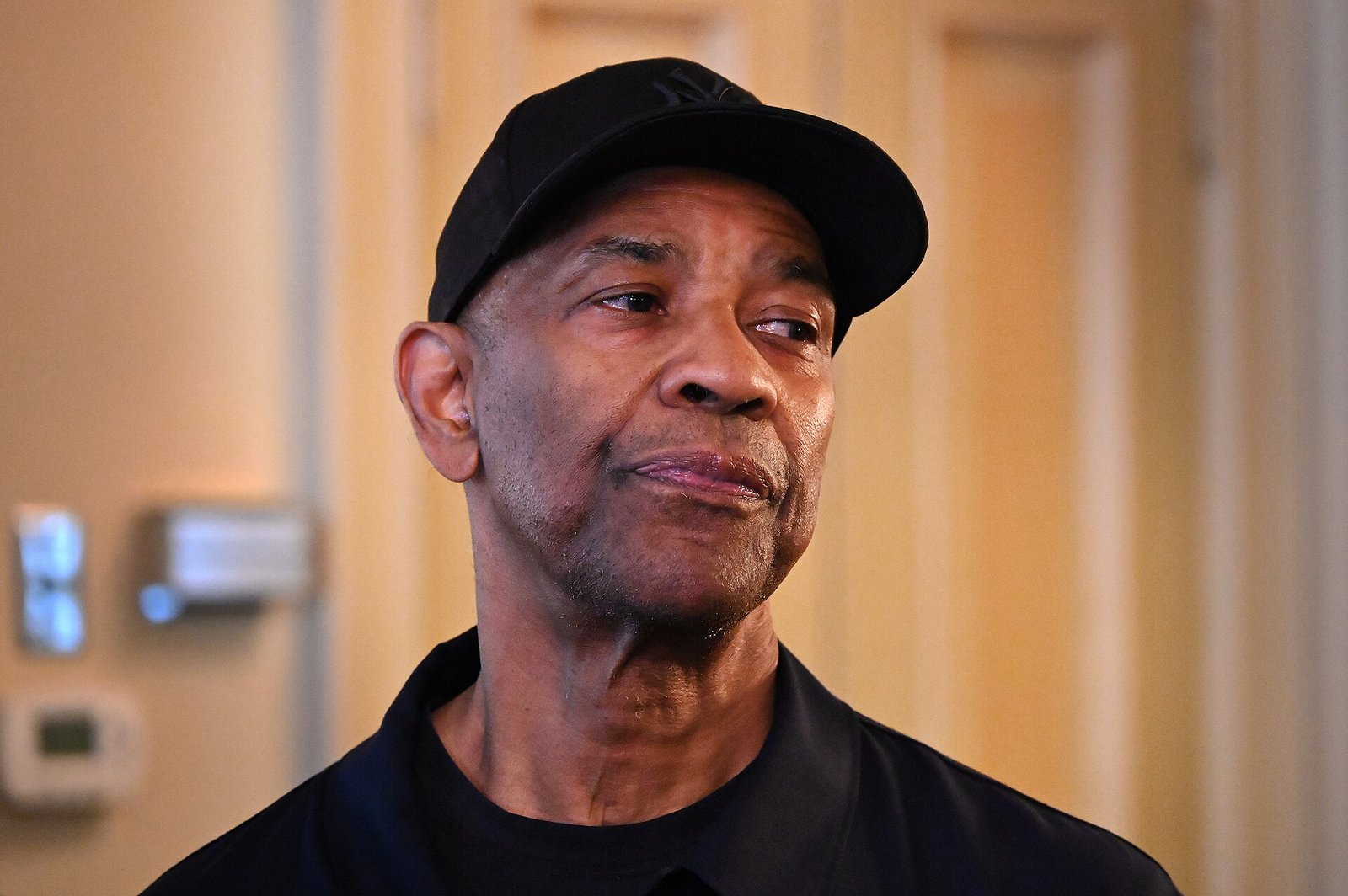
The Denzel Washington File: Net Worth, Age, Wife, Family and Career Facts
How Denzel Went from Mount Vernon to St. Elsewhere, Cry Freedom and Glory
Denzel Washington’s standing in his profession has been settled for some decades: two Academy Awards from ten nominations, a Tony Award, and a run of leading performances — from Malcolm X to Training Day to Fences — that few contemporaries can match. He has directed as well as acted, produced through his own company, and kept a working rate of roughly a production a year across more than forty years without the dips that mark most careers of that length.
Then came 2025, a year that would have constituted a career peak for most actors, undertaken at seventy: the Presidential Medal of Freedom in January, the title role in Othello on Broadway from February to June in a run that broke box-office records for a play, an honorary Palme d’Or presented at Cannes in May, and Highest 2 Lowest, his fifth production with Spike Lee. This profile sets out the record in order — the early years in Mount Vernon, the work decade by decade, his wife and family, the facts in full, and then the money, including the range of figures other trackers publish and the distinction between his earnings and his wealth.
A 1950s Childhood in Mount Vernon
Denzel Hayes Washington Jr. was born on 28 December 1954 in Mount Vernon, New York, and grew up there and in the Bronx. His father, Denzel Hayes Washington Sr., was a Pentecostal minister who also worked for the city water department and for a department store; he died in 1991. His mother, Lennis “Lynne” Washington, née Lowe, owned and ran beauty parlours in the Bronx and Mount Vernon; she died in 2021, at the age of 97. His parents divorced when he was fourteen, and he was sent to a private preparatory school in New Windsor, New York — a change he has credited, plainly and often, with removing him from streets on which several of his closest friends of that age later went to prison or were killed. The account is his own, given in interviews over many years, and it is the foundation story he returns to when asked about discipline.
He attended Fordham University, intending at different points to study medicine, law and journalism, and took a degree in drama and English in 1977 after a summer working as a counsellor at a camp in Connecticut persuaded him to try acting seriously. He studied for a period at the American Conservatory Theater in San Francisco before leaving for professional work in New York. His first screen role came in the television production Wilma (1977), about the sprinter Wilma Rudolph — where, as set out in this profile, he also met his future wife. His biography from there is one of steady accumulation: no single overnight breakthrough, but a decade of television and supporting parts that left him, by 1989, established as the leading dramatic actor of his generation.
From St. Elsewhere, Cry Freedom and Glory to The Equalizer, Fences on Screen, Gladiator II and Othello
1981–1989: St. Elsewhere, Cry Freedom and Glory
His first cinema role was in the comedy Carbon Copy (1981). The part that made him a familiar face came on television: from 1982 to 1988 he played Dr Philip Chandler in the hospital drama St. Elsewhere, six seasons of steady, serious work that let him build a cinema career alongside it. A Soldier’s Story (1984) brought critical notice. In Cry Freedom (1987) he played the murdered activist Steve Biko and received his first Academy Award nomination. Glory (1989), in which he played Private Trip, a soldier in a Black regiment of the Civil War, brought his first Academy Award, for Best Supporting Actor. By the end of the decade the terms of the career were set: serious material, leading or near-leading parts, and a reputation for preparation that directors relied on.
1990–2001: Malcolm X, Philadelphia and Training Day
Mo’ Better Blues (1990) began a collaboration with Spike Lee that has now run to five productions. Malcolm X (1992), in which he played the title role across twenty years of the man’s life, brought an Academy Award nomination and remains, for many critics, his finest performance. Much Ado About Nothing, The Pelican Brief and Philadelphia all followed in 1993; in the last of them he starred opposite Tom Hanks, and readers may also want Tom Hanks’s net worth profile for the companion account of his co-star. Crimson Tide and Devil in a Blue Dress (1995), Courage Under Fire (1996), He Got Game (1998) and The Hurricane (1999), in which he played the wrongly imprisoned boxer Rubin Carter to another Academy Award nomination, kept the run at an unusually high level. Remember the Titans (2000) was a large popular success. Training Day (2001), in which he played a corrupt Los Angeles detective, brought his second Academy Award, for Best Actor — the second such win by a Black performer in the award’s history, after Sidney Poitier’s nearly four decades earlier.
2002–2013: Directing, American Gangster and Flight
He added directing to acting without reducing either. Antwone Fisher (2002), his first production as director, was well received; The Great Debaters (2007) followed. As an actor the decade ran through Man on Fire (2004), Inside Man (2006), his most commercially successful collaboration with Lee, and American Gangster (2007), in which he played the heroin trafficker Frank Lucas opposite Russell Crowe; the production took more than $260 million worldwide. The Taking of Pelham 123 (2009), The Book of Eli and Unstoppable (both 2010) maintained a working rate of roughly a production a year at fees reported in the region of $20 million. On stage he won the Tony Award for Best Actor in 2010 for the Broadway revival of August Wilson’s Fences, opposite Viola Davis. Flight (2012), in which he played an airline pilot with an addiction he conceals until it can no longer be concealed, brought another Academy Award nomination. The performance was widely taken as one of his finest of the period precisely because it refused sympathy: the character lies, charms and evades for most of the running time, and the production’s considerable commercial success rested almost entirely on audiences staying with a man they were given every reason to abandon.
2014–2026: The Equalizer, Fences on Screen, Gladiator II and Othello
The Equalizer (2014) began his most durable late franchise: three productions across nine years, each a substantial commercial success, in which he played a retired intelligence operative of meticulous habits. In 2016 he directed and starred in the screen version of Fences, which brought him an Academy Award nomination as an actor and, as a producer, a nomination for Best Picture. Roman J. Israel, Esq. (2017) and The Tragedy of Macbeth (2021), for Joel Coen, brought further nominations. In Gladiator II (2024) he played Macrinus, a former slave turned power broker in Rome, and drew some of the strongest reviews of the production. Then came 2025: the Presidential Medal of Freedom in January, a Broadway Othello opposite Jake Gyllenhaal that broke box-office records for a play and recouped its costs within three months, an honorary Palme d’Or presented at Cannes in May, and Highest 2 Lowest, his fifth production with Lee, in which he played a music-industry executive facing a ransom demand. He has spoken of working less, and of directing more, in the years ahead.
Life Beyond the Cameras With Pauletta Washington
He met the actress Pauletta Pearson in 1977, on the set of Wilma, his first screen production and one of her earliest. By his account he proposed more than once before she accepted. They married on 25 June 1983, and renewed their vows in 1995 in a ceremony officiated by Archbishop Desmond Tutu. Pauletta Washington has therefore been his wife for more than forty years — among the longest marriages in his profession, and one both parties discuss, when they discuss it at all, in terms of work and faith rather than romance. His parents’ example sits behind the account he gives of himself: a minister father and a mother who ran her own businesses, and a marriage of his own that has lasted the whole of his public life.
They have four children, all of whom work in the industry their parents built their lives in. John David Washington, born on 28 July 1984, played professional football before turning to acting, and has led productions including BlacKkKlansman and Tenet; he also starred in the stage production of The Piano Lesson in 2022 and its screen version, which his father produced. Katia Washington, born on 27 November 1986, is a producer who has worked on several of the family’s productions. The twins, Olivia and Malcolm Washington, were born on 10 April 1991: Olivia is an actress, and Malcolm directed his first feature, the screen adaptation of The Piano Lesson, in 2024, with his father producing and John David in the cast — a family production in the literal sense. Washington has no verified personal Instagram account, which is how that pattern in his keyword set is answered in the table: he does not maintain a public account, and statements from him reach the public through interviews and official occasions.
The Earnings Trail From St. Elsewhere, Cry Freedom and Glory to Now
Celebrity Net Worth puts Denzel Washington’s net worth at $300 million, and that is the figure carried in this profile, attributed to that source. The range disagreement is recorded in full: trackers outside the sources this profile relies on place the figure anywhere from about $280 million to $350 million, and that spread is noted here without being adopted. Forbes publishes no wealth total for him at all — its coverage is earnings-based, including a 2025 entertainment-earnings estimate of $38 million after fees — and earnings are kept distinct from wealth throughout this profile. The same distinction applies to his reported fee of about $35 million for Highest 2 Lowest: that is a salary, not a component of the net-worth figure itself. The basis of the estimate is four decades of leading-man fees — a reported rate in the region of $20 million a production through his peak years, higher for individual productions since — plus producing income through his company, Mundy Lane Entertainment, and the returns of a long-held property portfolio.
The Beverly Park Residence, 29,000 Square Feet
The property at the centre of the record is the family home in Beverly Park, Los Angeles: a very large residence of roughly 29,000 to 30,000 square feet in a gated community, which he and his wife assembled from land bought in the 1990s — two lots acquired from the then Disney chairman Michael Eisner at a reported price close to $6.5 million — and built on over the following years. Reports of its current value vary widely and are not treated here as reliable. In April 2022 the couple paid $10.9 million for a condominium in Century City, Los Angeles, previously owned by a member of the Saudi royal family. No complete inventory of the couple’s property has been published, and the figures above are reported transaction prices, not a present valuation of what they hold.
The Complete Record for Denzel Washington
| The Complete Record for Denzel Washington | Details |
|---|---|
| Full Name | Denzel Hayes Washington Jr. |
| Born | 28 December 1954, Mount Vernon, New York |
| Birthday | 28 December |
| Age | 71 |
| Height | 6 ft 1 in (1.85 m) |
| Weight | No reliable published figure exists |
| Wife | Pauletta Washington, née Pearson (married 25 June 1983) |
| Children | Four — John David Washington (born 28 July 1984), Katia Washington (born 27 November 1986) and twins Olivia and Malcolm Washington (born 10 April 1991) |
| Parents | Denzel Hayes Washington Sr. and Lennis “Lynne” Washington, née Lowe |
| Family | Wife Pauletta; children John David, Katia, Olivia and Malcolm |
| Movies and TV Shows | Includes Wilma (1977), St. Elsewhere (1982–1988), Glory (1989), Malcolm X (1992), Philadelphia (1993), Training Day (2001), American Gangster (2007), Fences (2016), Gladiator II (2024) and Highest 2 Lowest (2025) |
| House | Beverly Park residence, Los Angeles; Century City condominium (bought April 2022) — see The Earnings Trail From St. Elsewhere, Cry Freedom and Glory to Now |
| No verified personal account | |
| Net Worth | $300 million — Celebrity Net Worth |
For his weight, no reliable published figure exists, so the table says so plainly rather than repeating a number no authority stands behind. The Instagram row records that he maintains no verified personal account.
What the Long Run Proves About Denzel
At 71, Washington’s position is best measured by 2025 itself: a medal from a president, an honour from Cannes, a record-breaking Broadway run and a leading role for the director he has worked with for thirty-five years, in a single year, at an age when most of his contemporaries have stopped. The career underneath it — ten Academy Award nominations, two wins, a Tony, a directing body of work and a production company — was built without a franchise until he was nearly sixty.
The $300 million estimate is the financial residue of that working life; the reputation, which is the larger asset, is not the kind that appears in a table. On his own account he intends to work less and direct more, and the family production of The Piano Lesson suggests the shape of what comes next: the name continuing, increasingly, through the work of his children.