
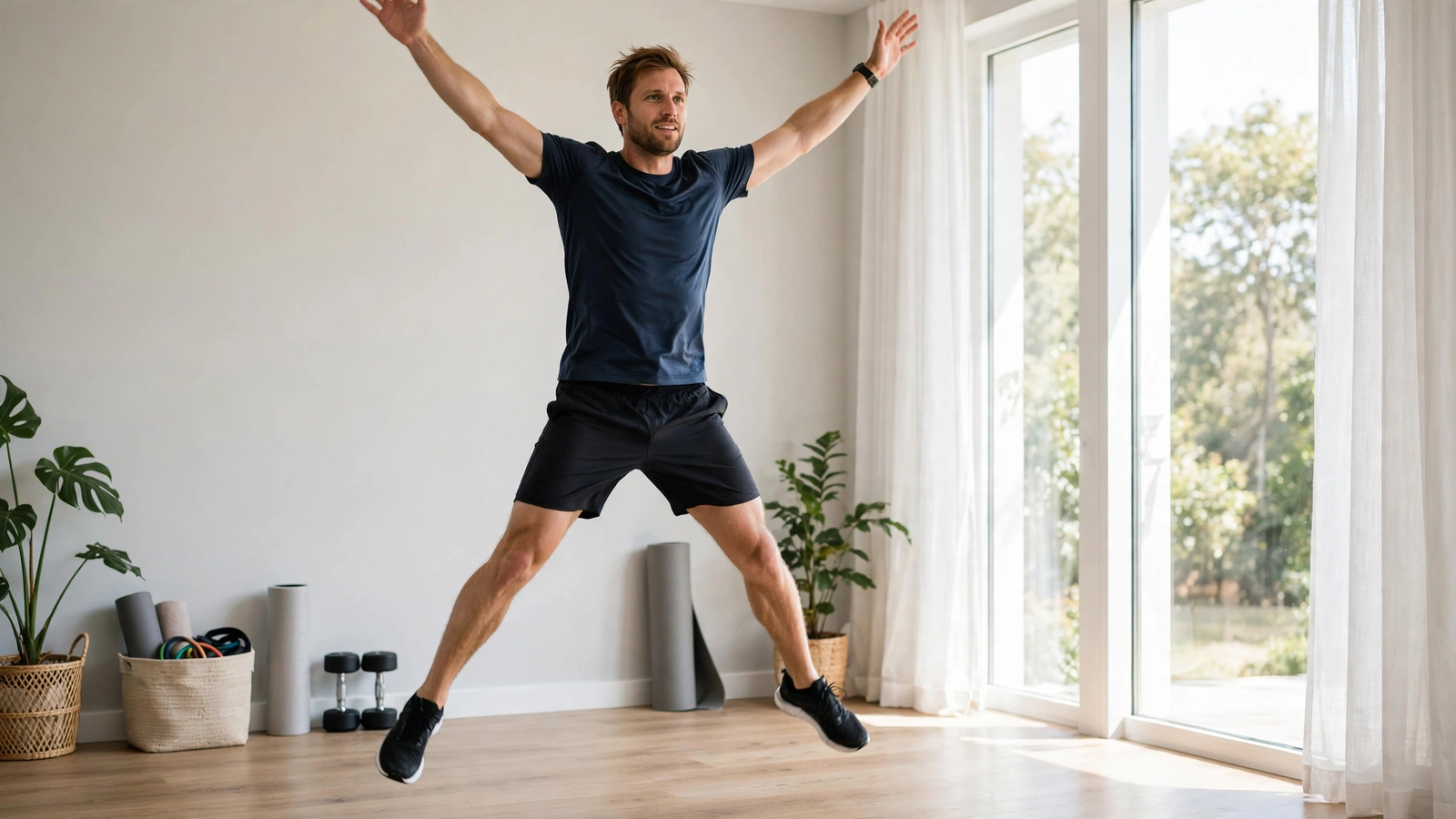
Jumping jacks are one of the simplest cardio exercises in existence — no equipment, no gym membership, barely any space needed. They are a staple of warm-ups, HIIT workouts, and home fitness routines across the UK. But if you are counting calories, the natural question is: exactly how many jumping jacks does it take to burn 100 calories?
In this guide, we give you the precise numbers for different body weights, explain the science behind the calculation, and show you how to use jumping jacks effectively for fat loss and fitness.
How Many Jumping Jacks Burn 100 Calories?
The number depends mainly on your body weight, because heavier bodies require more energy to move:
- 55 kg (8.7 stone): around 650–700 jumping jacks (≈ 14–15 minutes)
- 70 kg (11 stone): around 550–600 jumping jacks (≈ 11–13 minutes)
- 85 kg (13.4 stone): around 450–500 jumping jacks (≈ 9–11 minutes)
- 100 kg (15.7 stone): around 400–450 jumping jacks (≈ 8–10 minutes)
These figures assume a moderate, steady pace of about 50 jumping jacks per minute. Go faster and you will burn calories quicker; slow down and it takes longer. For the bigger picture on structuring effective sessions, see our guide on how many sets to do per workout.
How the Calculation Works
Exercise scientists measure activity intensity in METs (metabolic equivalents). Vigorous jumping jacks rate at roughly 8 METs, meaning they burn about 8 times the calories you use at rest.
The formula is: calories per minute = (METs × 3.5 × weight in kg) ÷ 200. For a 70 kg person doing vigorous jumping jacks: (8 × 3.5 × 70) ÷ 200 ≈ 9.8 calories per minute. That means 100 calories takes just over 10 minutes — roughly 500–550 jacks at a steady pace.
At a gentler pace, jumping jacks drop to around 6 METs, so everything takes about a third longer. Intensity genuinely matters.
Calories Per Minute at Different Intensities
- Easy pace (30 jacks/min): 5–7 calories per minute for most adults
- Moderate pace (50 jacks/min): 8–11 calories per minute
- Vigorous pace (70+ jacks/min): 11–15 calories per minute
Most people naturally settle into a moderate pace. If you can hold a conversation, you are going easy; if you can only gasp out a few words, you are in the vigorous zone.
Jumping Jacks vs Other Exercises (100 Calories)
How do jumping jacks compare for burning 100 calories?
- Jumping jacks (moderate): 10–13 minutes
- Running (6 mph): 8–10 minutes
- Cycling (moderate): 12–15 minutes
- Brisk walking: 20–25 minutes
- Swimming (moderate): 12–15 minutes
Jumping jacks hold their own impressively — they are among the most time-efficient bodyweight exercises. For a walking-based comparison, read how many calories you burn walking two miles.
Step-by-Step: Proper Jumping Jack Form
Good form burns more calories and protects your joints:
- Start position. Stand tall with feet together, arms at your sides, core lightly braced.
- Jump out. Jump your feet out to shoulder width while raising your arms overhead in one smooth motion.
- Land softly. Land on the balls of your feet with knees slightly bent to absorb impact. Avoid landing flat-footed.
- Jump back. Immediately jump your feet back together while lowering your arms.
- Keep rhythm. Aim for a steady, controlled pace rather than frantic flailing. Breathe naturally — exhale on the jump out if it helps.
- Protect your joints. If you have knee or ankle issues, try low-impact “step jacks” (stepping side to side instead of jumping) — you still burn meaningful calories.
How to Use Jumping Jacks for Fat Loss
Jumping jacks alone will not transform your body, but they are an excellent tool within a broader plan:
- As a warm-up: 2–3 minutes of jumping jacks raises your heart rate before strength training.
- In HIIT circuits: Alternate 40 seconds of jumping jacks with 20 seconds rest, repeated 8–10 times, for a potent 15-minute fat-burning session.
- As active breaks: Doing 100 jumping jacks every hour during a sedentary workday adds up to significant extra calorie burn.
- Combined with diet: Exercise helps, but fat loss ultimately requires a calorie deficit. Jumping jacks make the exercise side easy and free.
If you are building a complete routine from scratch, our step-by-step guide to starting a fitness journey walks you through the whole process.
Beginner Modifications
If full jumping jacks feel too intense:
- Step jacks: Step one foot out at a time instead of jumping. Roughly 60–70% of the calorie burn with far less impact.
- Half jacks: Raise arms only to shoulder height instead of overhead.
- Interval approach: Do 30 seconds of jacks, 30 seconds of marching in place, and repeat.
Start with what you can do and build up. Consistency beats intensity when you are beginning.
Common Mistakes
- Landing stiff-legged. This jars the knees. Always land with soft knees.
- Hunching forward. Keep your chest up and core engaged.
- Holding your breath. Breathe rhythmically; oxygen fuels the burn.
- Doing them on hard floors barefoot. Wear supportive trainers, especially on tile or concrete.
- Expecting spot reduction. Jumping jacks burn calories overall — they do not specifically melt belly fat. Fat loss happens body-wide.
Jumping Jack Variations That Burn Even More
Once standard jumping jacks feel easy, these variations raise the intensity:
- Star jumps: Explode upward at the top, spreading arms and legs wide mid-air. Roughly 20–30% more calories per minute than regular jacks.
- Plyo jacks: Add a squat at the bottom of each rep. Works the legs harder and spikes the heart rate.
- Cross jacks: Cross arms and legs in front on each rep instead of out to the sides. Great for coordination and obliques.
- Seal jacks: Clap hands together in front of your chest (like a seal) instead of overhead. Easier on the shoulders.
- Weighted jacks: Hold light dumbbells (1–2 kg). Even small weights noticeably increase the burn.
Rotate through variations in a circuit — 40 seconds of each with 20 seconds rest — for a 10-minute session that torches 100–150 calories.
Sample 100-Calorie Jumping Jack Workout
Here is a complete session designed to burn roughly 100 calories in about 12 minutes:
- Warm-up (2 min): March in place, arm circles, gentle step jacks.
- Round 1 (3 min): 1 minute regular jacks, 30 seconds rest, 1 minute step jacks, 30 seconds rest.
- Round 2 (3 min): 40 seconds star jumps, 20 seconds rest, 40 seconds cross jacks, 20 seconds rest, 40 seconds seal jacks, 20 seconds rest.
- Round 3 (2 min): 1 minute regular jacks at a strong pace, 1 minute slow cool-down jacks.
- Cool-down (2 min): Walk in place, stretch calves, quads, and shoulders.
Do this 4–5 times a week alongside a sensible diet and you will burn an extra 400–500 calories weekly — enough to lose around 0.25 kg per month from this alone.
FAQs
How long does it take to do 500 jumping jacks?
At a moderate pace of 50 per minute, 500 jumping jacks takes about 10 minutes. Beginners might take 12–15 minutes with short breaks. You do not need to do them all at once — splitting them across the day works just as well for calorie burn.
Are jumping jacks good for losing belly fat?
Jumping jacks burn calories and improve cardiovascular fitness, which contributes to overall fat loss — including belly fat over time. However, no exercise targets fat in one specific area. Combine regular cardio like jumping jacks with a calorie-controlled diet for the best results.
How many calories do 100 jumping jacks burn?
Roughly 15–25 calories for most adults, depending on weight and intensity. A 70 kg person doing moderate-paced jumping jacks burns about 20 calories per 100 jacks. It takes around 500 of them to reach 100 calories.
Can I do jumping jacks every day?
Yes, most people can do moderate jumping jacks daily, especially in shorter bouts. They are low-skill and joint-friendly when done with good form. If your knees, ankles, or shins feel sore, take a rest day or switch to low-impact step jacks. The NHS physical activity guidelines encourage daily movement of this kind.
Do jumping jacks build muscle?
Not significantly. Jumping jacks mainly train cardiovascular endurance and coordination in the legs, shoulders, and core. For muscle building, add resistance training — see our guide on how to gain muscle for a complete approach.




Leave a Reply