
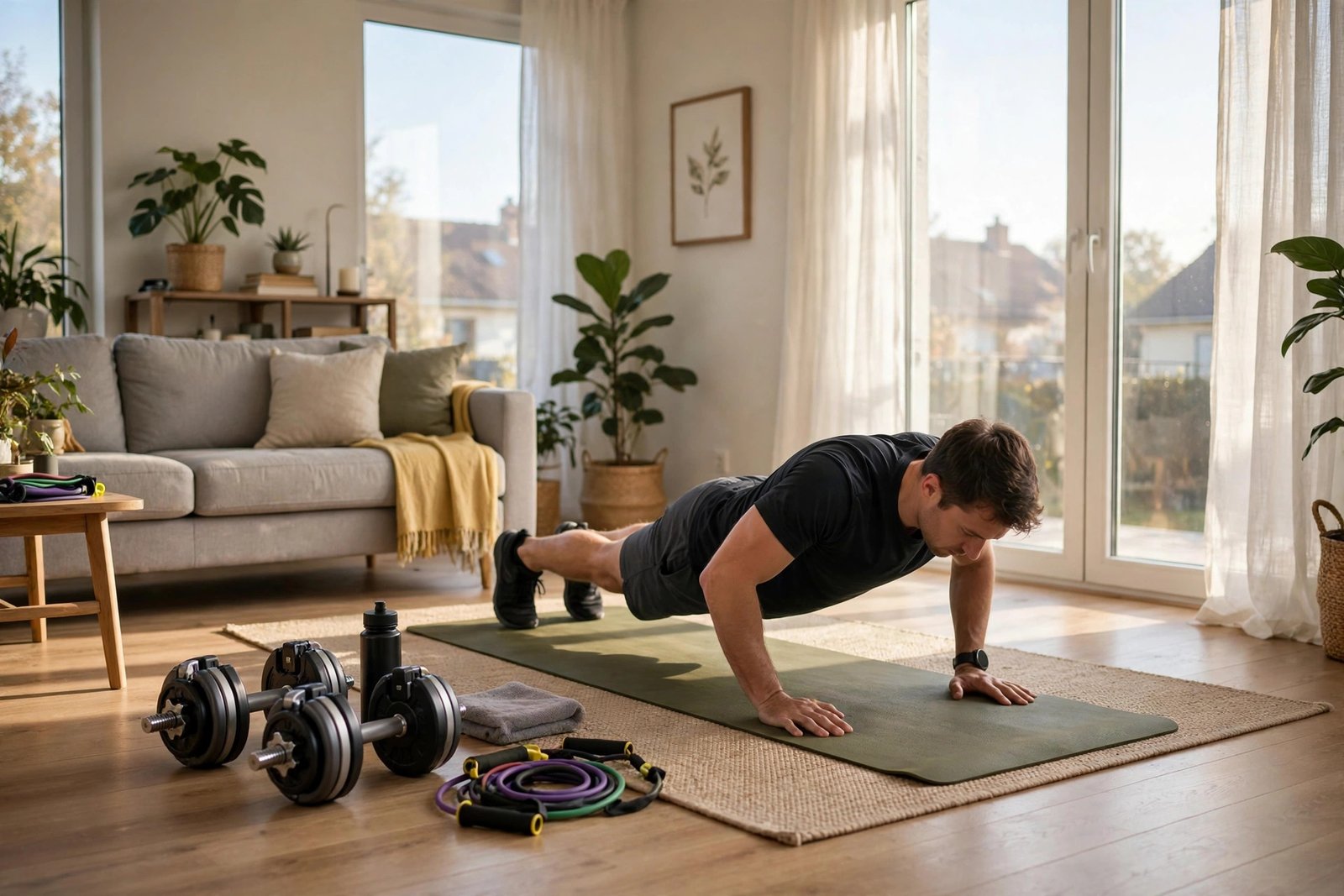
You don’t need a gym membership to build serious muscle. No commute, no monthly direct debit, no waiting for the squat rack while someone scrolls their phone on it. With the right approach, your living room, a park, or a spare corner of the bedroom can be a perfectly effective muscle-building environment — and the science backs it up: muscles respond to tension, not to postcodes.
Here’s how to build real, visible muscle at home in the UK — the equipment worth buying, the programme that works, and the nutrition that makes it all count.
The science: why home workouts build muscle just as well
Muscle growth (hypertrophy) is triggered by mechanical tension, muscle damage and metabolic stress — none of which require a commercial gym. Research consistently shows that training close to failure with sufficient volume builds muscle regardless of location. A 2020s body of studies confirmed that even light loads (30% of max) build comparable muscle to heavy loads when sets are taken near failure — which is excellent news for home trainees without a barbell loaded with plates. What matters: progressive overload (gradually doing more), consistency, and eating enough protein. The venue is almost irrelevant.
The minimal equipment that punches above its weight
You can start with zero equipment, but £100–£150 of kit transforms what’s possible:
1. Adjustable dumbbells (£60–£100)
The single best home-gym purchase. Dial-a-weight dumbbells replace an entire rack, enabling progressive overload on presses, rows, curls and lunges. An AI-generated workout plan can personalise the programme below to your equipment and schedule — and check Which? reviews for adjustable dumbbell comparisons before you buy.
2. Pull-up bar (£20–£30)
Doorway-mounted bars unlock the best upper-body exercise in existence — pull-ups and chin-ups build lats, biceps and grip like nothing else. Can’t do one yet? Start with dead hangs and negatives; most people get their first full pull-up within 6–12 weeks.
3. Resistance bands (£15–£25)
Perfect for warm-ups, accessory work, and adding tension where dumbbells can’t. A set with door anchor covers rows, face pulls, pushdowns and more. They also travel — hotel-room workouts sorted.
4. A sturdy bench or plyo box (£40–£60, optional)
Elevates pressing movements and enables step-ups, Bulgarian split squats and dips. A sturdy chair works for many exercises if budget is tight.
Total: under £150 for a setup that covers every major movement pattern. Compare that to £40–£60/month gym fees — it pays for itself in three months.
The programme: a simple, proven split
Forget complicated routines. This full-body programme, three days a week (e.g. Mon/Wed/Fri), hits everything:
Workout A
Goblet squats (dumbbell) 3×10–12; push-ups 3× near-failure (elevate feet or add a loaded backpack as you progress); one-arm dumbbell rows 3×10–12 each; dumbbell Romanian deadlifts 3×10–12; plank 3×45–60 seconds.
Workout B
Bulgarian split squats 3×8–10 each leg; dumbbell overhead press 3×8–12; pull-ups or band-assisted pull-ups 3× near-failure; dumbbell floor press 3×10–12; band face pulls 3×15.
The progression rules
When you hit the top of the rep range on all sets with good form, increase weight (or reps, or difficulty — e.g. archer push-ups) next session. Log every workout — a notes app suffices. Progressive overload is the entire game; without it, you’re exercising, not building. Rest 60–90 seconds between sets, and never train the same muscles hard two days running — growth happens in recovery. For motivation systems that keep you consistent, see staying motivated at home.
Bodyweight-only: the zero-cost path
No kit at all? You can still build impressive muscle with progressive calisthenics: push-up progressions (incline → standard → diamond → archer → one-arm), squat progressions (bodyweight → Bulgarian split → pistol), and pull-up progressions using a park bar. The ceiling is lower than with weights, but the first 12–18 months of gains are very real. Our guide to exercising without a gym covers the broader approach, and low-impact options suit those managing joints.
Nutrition: the half of muscle-building most people skip
Protein: the headline number
Aim for 1.6–2.2g of protein per kg of bodyweight daily (a 75kg person: 120–165g). UK-friendly sources: chicken, turkey, eggs, Greek yoghurt, cottage cheese, tinned tuna, lentils, and whey protein (£15–£20/kg — the cheapest complete protein available). Spread intake across 3–4 meals; the “anabolic window” is mostly myth, but daily totals matter enormously.
Calories: eat to grow
Building muscle requires a slight calorie surplus — roughly 200–300 above maintenance. Too little and you won’t grow; too much and you gain fat. Track for two weeks to find your maintenance, then add modestly. The NHS healthy weight guidance helps you calibrate sensibly.
Sleep: the legal performance enhancer
Muscle is built during sleep via growth hormone release. Under 7 hours consistently and your gains suffer measurably — training hard on 5 hours is like revving a car with no oil. Protect your sleep as seriously as your workouts.
Common home-training mistakes
Training to failure on every set (leaves you wrecked — 1–2 reps in reserve is the sweet spot for most sets); programme-hopping every three weeks (stick with one programme 12+ weeks); ignoring legs (the biggest muscles drive the most growth); no progression tracking; and under-eating protein while wondering why nothing changes. Fix these five and home training works as well as any gym.
Tracking progress without a gym
You can’t manage what you don’t measure. Track three things: your workout log (exercises, weights, reps — progressive overload made visible), monthly photos (front, side and back in the same lighting — the mirror lies daily but photos don’t lie monthly), and key measurements (chest, arms, thighs and waist with a tape measure every four weeks). Strength gains show in the log within weeks; visible changes show in photos within eight to twelve weeks. When progress stalls for three weeks or more, change one variable — add a set, increase the weight, eat slightly more, or sleep more — never overhaul everything at once. This feedback loop is what turns random home workouts into a genuine training programme.
The bottom line
Building muscle without a gym in the UK comes down to: £100–£150 of smart equipment (or just your bodyweight), a simple progressive programme done 3x weekly, 1.6–2.2g/kg of protein daily, a slight calorie surplus, and 7+ hours of sleep. Do that consistently for six months and the mirror will show it — no membership required. The gym is a tool, not a prerequisite; tension, food and recovery are the actual ingredients, and all three are available at home.
Frequently Asked Questions
Can you build muscle with just bodyweight exercises?
Yes, especially in the first 12–18 months, using progressive variations (archer push-ups, pistol squats, pull-up progressions). Adding dumbbells raises the ceiling significantly.
How often should I work out at home to build muscle?
3 full-body sessions per week is ideal for beginners — enough stimulus with enough recovery. More isn’t better; muscles grow between sessions, not during them.
How much protein do I need to build muscle?
1.6–2.2g per kg of bodyweight daily. A 75kg person needs roughly 120–165g — achievable with 3–4 protein-rich meals plus optionally a whey shake.
How long until I see muscle gains at home?
Strength increases in 2–4 weeks (neural adaptation); visible muscle growth typically 8–12 weeks with consistent training and nutrition. Photograph monthly — daily mirror checks lie.
Do I need supplements to build muscle at home?
No — whey protein is convenient but optional; creatine monohydrate (£10–£15 for months) is the only supplement with strong evidence, and even it’s optional. Food, training and sleep do 95% of the work.


Leave a Reply