
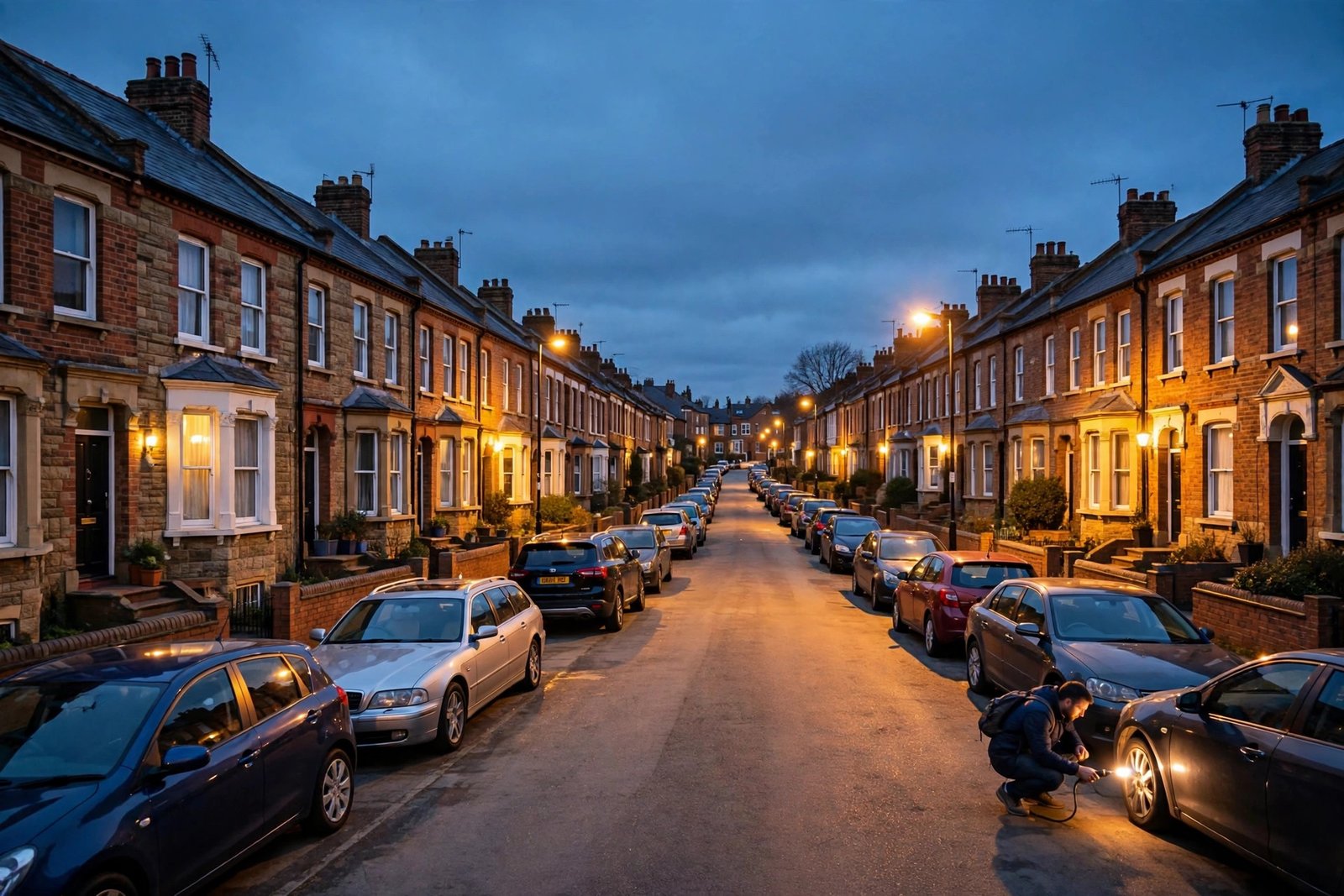
Millions of British motorists park on the street — terraced houses, city flats and Victorian conversions across the country were built before the car, let alone the driveway. Keeping a car healthy without off-street parking brings real challenges: no home charging for EVs, nowhere to plug in a trickle charger, exposure to weather and thieves, and the eternal hunt for a space near your front door. But street-parked cars can live long, reliable lives with the right habits.
Here’s how to keep your car running sweetly when a driveway is a distant dream.
Battery: the number-one street-parking killer
The most common no-driveway failure is a flat battery. Short urban trips don’t recharge what starting consumes, cold weather saps capacity, and modern cars’ always-on electronics (alarms, keyless systems) drain steadily when parked. Prevention: take the car for a proper 20–30 minute run weekly (not just idling — driving charges far better); if you barely drive, a solar trickle charger on the dashboard (£25–£40) feeds the battery through the windscreen with no mains needed; and know the signs of a dying battery (slow cranking, dim lights) before it strands you. A portable jump starter (£50–£80) in the boot is the best £60 a street-parker will spend — self-rescue beats waiting for the RAC in the rain. The RAC’s battery advice pages cover testing and replacement intervals.
Security without a driveway
Street-parked cars are more exposed — to theft, break-ins and vandalism. Layer your defences: always lock and check (keyless cars: store fobs in a Faraday pouch, £10, to block relay theft — the UK’s fastest-growing car crime); never leave anything visible, including charging cables and loose change; park under streetlights and CCTV where possible; consider a visible deterrent (steering lock, £25 — thieves choose easier targets); and check whether your area qualifies for a police-approved marking scheme. Dash cams with parking mode (£100–£150) record bumps and break-ins while parked — invaluable for insurance claims. Tell your insurer where the car is kept overnight: “on street” vs “driveway” affects premiums, and misdeclaring can void claims. Our broader home security principles — lighting, visibility, deterrence — apply equally to vehicles.
Weather protection and maintenance
Winter: the danger season
Frost, road salt and damp punish street-parked cars. Use a windscreen cover (£10) instead of scraping (scraping damages wipers and screens); keep de-icer and a proper scraper in the car, not the house; wash salt off regularly — it corrodes bodywork and brake lines; check antifreeze/coolant strength before winter; and keep tyres properly inflated (pressure drops in cold, hurting grip and economy). Never leave a car idling unattended to defrost — it’s illegal (unnecessary idling) and an invitation to thieves.
Year-round essentials
Service on schedule regardless of mileage — time-based servicing matters for low-mileage cars (oil degrades sitting still); check tyre pressures monthly (street parking often means kerb-mounting, which damages sidewalls — inspect them); keep the fuel tank above a quarter (condensation forms in near-empty tanks); and run the air conditioning for 10 minutes monthly even in winter (keeps seals lubricated and prevents the musty failure that greets spring).
MOT and legal musts
Street-parked cars still need valid MOT, tax and insurance — check GOV.UK’s MOT guidance for reminders and test rules. If the car will sit unused for weeks, consider SORN (Statutory Off Road Notification) — but only if it’s on private land; SORN cars can’t sit on public roads.
The EV question: no driveway, no home charger?
This is the crunch issue for street-parkers considering electric. Without home charging you rely on: workplace charging (increasingly common — ask), public rapid chargers (fine for weekly top-ups but pricier per kWh), lamppost and bollard chargers (rolling out across UK cities — check your council’s map), and supermarket charging while you shop. It’s workable for many — plenty of flat-dwellers run EVs happily — but be honest about the hassle factor versus a petrol car you fuel in five minutes. The government’s on-street charging rollout continues, but coverage is patchy: research your specific streets before committing. For the buying decision itself, research the market carefully before committing.
Parking permits and neighbour diplomacy
Many urban streets need residents’ parking permits (£50–£200/year depending on borough — check your council). Apply early; waiting lists exist in the busiest zones. The unwritten rules matter too: don’t save spaces, don’t block driveways (illegal), keep a car’s length from junctions, and if you have two cars on a crowded street, consider whether you need both. Good neighbour relations are worth more than the perfect space — the neighbour who texts you “your lights are on” saves batteries and friendships.
Budgeting for street-parked car life
Street parking adds costs: permits, potentially higher insurance, more frequent cleaning, and the security kit above (£150–£250 one-off). Build car costs into a proper budget — our budgeting guide and money-saving ideas help you see the true cost of motoring. And if the numbers don’t work, be honest: in many UK cities, a car club membership or good public transport beats ownership financially. The free MoneyHelper car-costs guidance helps you compare.
When street parking stops working
Sometimes the honest answer is that car ownership doesn’t fit your street. The signs: you’re paying £200+ a month in permits, insurance loadings and repairs while driving under 3,000 miles a year; the car sits unused for weeks (disuse damages cars — seals dry, batteries die, brakes seize); or every parking experience involves a ten-minute hunt and mounting resentment. The alternatives have matured: car clubs offering hourly rental from bays near you (often cheaper below 6,000 miles a year), traditional hire for occasional long trips, and — in well-connected cities — the bus-train-bike combination millions manage happily. Do the full-cost maths: purchase, depreciation, insurance, tax, servicing, permits, fuel — divided by annual mileage. If it exceeds £1 per mile, alternatives almost certainly win. There’s no shame in it: the most economical car is often someone else’s, used only when you need it.
The bottom line
Keeping a car running without a driveway in Britain comes down to: protecting the battery (regular proper drives, solar trickle charger, jump starter in the boot), layering security (Faraday pouch, visible deterrents, honest insurance declarations), staying ahead of weather (winter prep, salt washing, scheduled servicing), and budgeting for the real costs. Thousands of street-parkers do it reliably for years — the car doesn’t know it lacks a driveway, as long as you compensate with attention. Do the basics consistently and your kerbside motor will be as dependable as any garaged one.
Frequently Asked Questions
How do I keep my car battery charged without a driveway?
Drive for 20–30 minutes weekly, use a dashboard solar trickle charger (£25–£40), and keep a portable jump starter in the boot. Short trips alone won’t maintain the charge.
Can I own an electric car without off-street parking?
Yes, using workplace, public rapid, lamppost and supermarket chargers — but research your area’s infrastructure first. It’s workable but less convenient than home charging.
How do I protect my car from theft on the street?
Faraday pouch for keyless fobs, visible steering lock, park under lights/CCTV, leave nothing visible, and consider a parking-mode dash cam. Declare on-street parking to your insurer.
Do I need a parking permit for my street?
Many urban UK streets require residents’ permits (£50–£200/year). Check your local council’s website — parking without one risks fines, and waiting lists exist in busy areas.
Is it illegal to leave my car idling to defrost it?
Leaving a vehicle unattended with the engine running on a public road is illegal in the UK and invalidates most insurance if stolen. Use a windscreen cover and de-icer instead.



Leave a Reply