
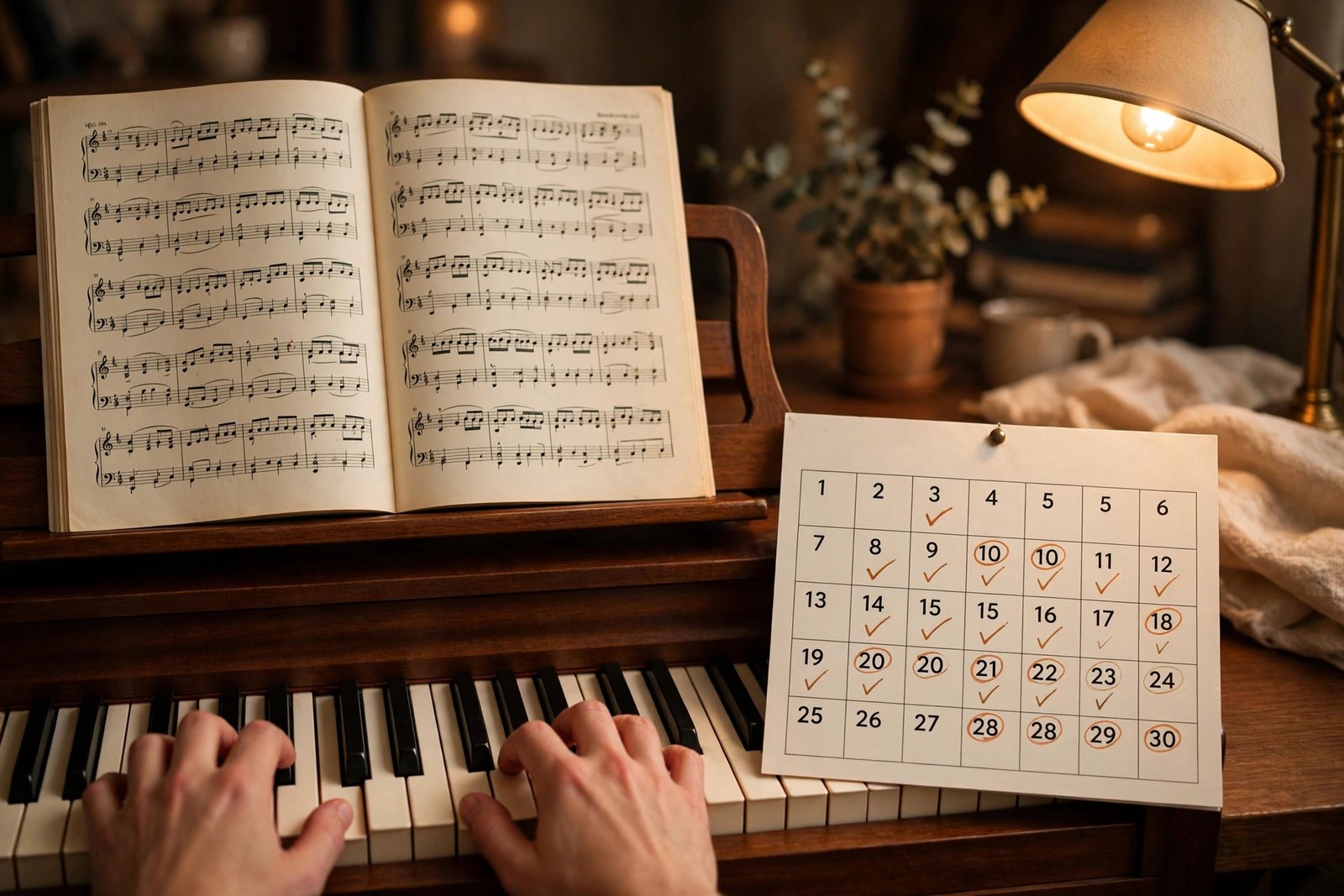
Sheet music looks like an alien language — dots, lines, squiggles, Italian words — and most adults assume learning it takes years of childhood lessons they never had. But here’s the secret music teachers know: reading music is a simpler skill than it appears, and an absolute beginner can go from zero to reading real melodies in 30 days with just 20–30 minutes of daily practice. Not virtuoso sight-reading — but genuine, functional music literacy.
This is your 30-day plan: the concepts in order, the daily practice that works, and the milestones to hit each week.
Before you start: what reading music actually involves
Music reading is three sub-skills, and separating them makes everything easier: pitch reading (which note — the vertical position on the staff), rhythm reading (how long — the note shapes and beams), and the physical mapping to your instrument (where that note lives under your fingers). Beginners try to learn all three simultaneously and drown; this plan layers them deliberately. You’ll need: your instrument (any — piano is ideal for visualising, but guitar, violin or even a recorder works), a method book or app (see below), manuscript paper or a notation app, and 20–30 minutes daily. Consistency beats duration — 25 minutes daily outperforms 3 hours on Sunday. If you’re starting an instrument from scratch too, our guides to easy beginner instruments and learning guitar as an adult pair perfectly with this plan.
Week 1: the staff, the notes, the absolute basics (Days 1–7)
Days 1–2: lines, spaces, and the treble clef
Learn the five lines and four spaces of the treble staff. Memorise the mnemonics: lines bottom-to-top are E-G-B-D-F (“Every Good Boy Deserves Fudge”); spaces spell F-A-C-E. That’s it — that’s the core insight. Drill with flashcards (physical or app) until you can name any line/space note in under 3 seconds. Boring? Yes. Foundational? Completely.
Days 3–4: notes above and below (ledger lines)
Middle C sits on a short “ledger line” below the staff — learn to count outward from known landmarks rather than memorising every ledger line individually. Practice: find landmarks (treble G on the second line, middle C below) and count steps to neighbours.
Days 5–7: sharps, flats and the bass clef (basics)
Learn accidentals (♯ raises a semitone, ♭ lowers) and meet the bass clef: lines G-B-D-F-A (“Good Boys Deserve Fudge Always”), spaces A-C-E-G (“All Cows Eat Grass”). Pianists need both clefs; single-line instrumentalists can focus on theirs. Milestone: name any note in either clef within 5 seconds.
Week 2: rhythm — the part everyone underestimates (Days 8–14)
Pitch gets the glory, but rhythm is where beginners actually fail. Learn note values: semibreve (4 beats), minim (2), crotchet (1), quaver (½), semiquaver (¼) — and their rests. The method: clap and count aloud, every day. “1-2-3-4” with claps on the beats, then subdividing (“1-and-2-and” for quavers). Use a metronome app — timing you can hear beats timing you must guess. Practice rhythms separately from pitches: clap the rhythm of a melody while just saying note names, then combine. ABRSM’s free theory resources include excellent rhythm exercises graded by difficulty.
Days 12–14: time signatures and bar lines
4/4 (four crotchet beats per bar), 3/4 (three — the waltz), 2/4, 6/8 (the compound feel). Understand that the top number counts beats, the bottom defines the beat unit. Practice identifying time signatures and counting bars of simple rhythms.
Week 3: putting it together on your instrument (Days 15–21)
Now the mapping: connect staff positions to physical locations. Pianists: find every C, then learn the landmark notes around them. Guitarists: learn the natural notes on each string progressively (start with the top two strings). This is the slowest phase — be patient. Method: play extremely simple melodies (nursery rhymes, folk songs you know by ear — knowing the tune lets you self-correct), saying note names aloud as you play, then playing from the notation alone. The BBC’s music education archives include beginner pieces with guided notation. Milestone: play 3–4 simple melodies from notation, slowly but correctly, without writing note names on the score (resist that temptation — it’s a crutch that delays real reading).
Week 4: fluency building (Days 22–30)
Daily sight-reading practice
The secret of readers: they practice reading new music, not perfecting old pieces. Spend 10 minutes daily sight-reading something new and easy — below your playing level, so the reading (not the technique) is the challenge. Hymn books, beginner method books, and free sheet music sites provide endless material. Keep a steady pulse even through mistakes; stopping to fix errors trains hesitation.
Learn key signatures
The sharps/flats at the start of each line (the key signature) — learn the order of sharps (F-C-G-D-A-E-B) and flats (B-E-A-D-G-C-F) and the major keys they define. Start with the common ones: G (1 sharp), F (1 flat), D (2 sharps), B♭ (2 flats). This unlocks real repertoire.
Milestone: read a real piece
By day 30, aim to sight-read a simple Grade 1–2 piece slowly but continuously — melody, rhythm and dynamics together. It won’t be performance-ready, but you’ll be reading music: the skill is built, and everything from here is refinement. Celebrate by finding live music near you — hearing notation come alive in concert is the best motivation there is.
Tools and resources
Apps: Tenuto (note identification drills — the best £4 in music education), Simply Piano/Flowkey (guided reading with feedback), Music Tutor (free flashcard drills). Books: ABRSM’s “Music Theory in Practice Grade 1” (the gold standard, cheap, systematic). Free: musictheory.net (superb interactive lessons), IMSLP (free sheet music library). Avoid: “learn piano in 7 days” apps that teach button-pressing without notation — they bypass reading entirely.
Common mistakes that waste the 30 days
Writing note names on the score (delays reading by months); practising only pitch and ignoring rhythm (rhythm is half the skill); irregular practice (the brain consolidates notation overnight — daily beats bingeing); jumping to hard pieces too soon (frustration kills motivation — stay easy); and neglecting the metronome (internal pulse must be trained deliberately). Dodge these five and the plan works.
The bottom line
Reading sheet music in 30 days is absolutely achievable: week 1 for notes, week 2 for rhythm, week 3 for instrument mapping, week 4 for fluency — 20–30 minutes daily, no shortcuts, no note-names written on scores. You won’t be sight-reading Chopin, but you’ll read real melodies with real understanding — a skill most adults assume is beyond them, built in a month. And it’s a foundation that compounds: every future piece gets easier, every musical door opens wider. The dots stop being alien. They start being music.
Frequently Asked Questions
How long does it take to learn to read sheet music?
Basic functional reading — simple melodies with correct pitch and rhythm — in about 30 days of daily 20–30 minute practice. Comfortable sight-reading takes 6–12 months of continued practice.
Is it harder to learn to read music as an adult?
No — adults often learn faster than children due to better practice discipline and pattern recognition. The “critical period” applies to perfect pitch and virtuoso technique, not basic literacy.
Do I need to read music to play an instrument?
No — many excellent musicians play by ear. But reading unlocks vastly more repertoire, accelerates learning, and is essential for classical, ensemble and session work.
What is the easiest way to memorise notes on the staff?
Mnemonics (Every Good Boy Deserves Fudge / FACE for treble clef), landmark notes (treble G, middle C), and daily flashcard drills. Counting from landmarks beats rote-memorising every position.
Should I learn treble or bass clef first?
Learn the clef your instrument uses: treble for violin, flute, guitar, trumpet; bass for cello, trombone, bassoon. Pianists need both — start with treble, add bass in week 1.



Leave a Reply