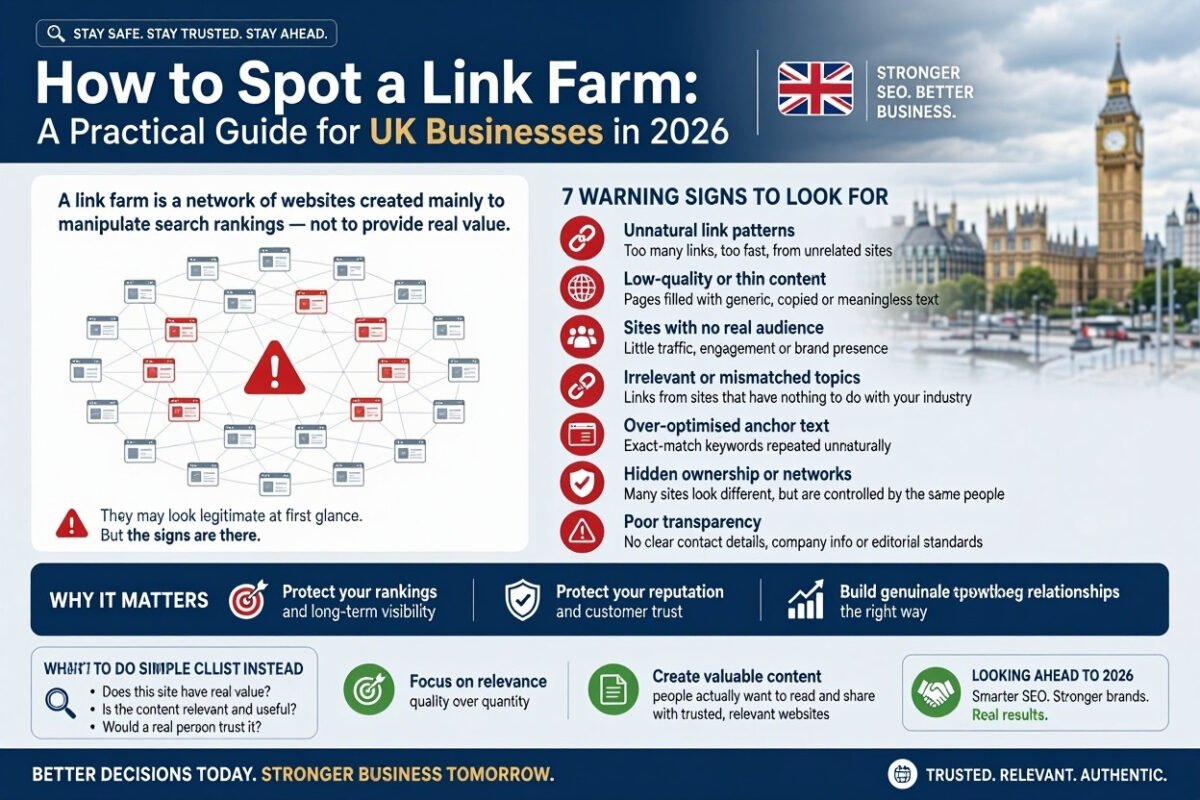
Backlinks can help people discover a business and give search engines useful context about its website. But a large number of links is not automatically a sign of authority. Some are created mainly to manipulate rankings, on networks of sites with little purpose beyond linking to one another. Knowing how to spot a link farm helps businesses avoid risky shortcuts and spend their marketing budget on work that can bring real readers and customers.
What makes a link farm different?
A link farm is a website, or group of websites, set up primarily to create or sell backlinks. It may publish articles across many unrelated subjects, with links inserted for search-engine benefit rather than because they help the reader. Some networks are obvious; others look like ordinary blogs at first glance.
The important distinction is purpose and pattern. A genuine publication may accept a relevant guest article, cite a useful source or link to a business it has reviewed. A site becomes concerning when its content appears to exist mainly as a vehicle for outbound links, particularly when those links are paid for or exchanged without meaningful editorial judgement.
Warning signs to check before accepting a link
- Unrelated topics sit side by side. A site that moves from UK property advice to pet nutrition, cryptocurrency and app development without a clear editorial focus may be publishing for link volume rather than a defined audience.
- Articles feel interchangeable. Thin pages, generic introductions, repeated structures and little original reporting can indicate that content is being produced to host links, not to answer readers’ questions.
- Outbound links dominate. Check several recent posts. If most contain multiple commercial links, especially to unrelated businesses, ask whether those references make sense in context.
- The site has little visible readership or identity. Look for named authors, an editorial purpose, a contact route and evidence of genuine engagement. Their absence is not proof on its own, but it adds to the picture.
- Link placement is sold as a ranking guarantee. Promises of a fixed number of backlinks, instant search gains or guaranteed positions deserve scepticism. Search performance depends on many factors; no publisher can responsibly guarantee a particular result from a link.
A quick due-diligence routine
Start by reading the site, not just its sales page. Open a handful of recent articles and ask whether you would find them useful if you had no interest in the linked business. Check that the linking page has a clear subject, that the destination genuinely supports the point being made, and that the article is written for people rather than stuffed with exact-match phrases.
Next, look at the site’s consistency over time. Does it have a recognisable readership and a coherent publishing history, or has it suddenly filled with a high volume of unrelated sponsored posts? Search the domain name alongside terms such as “guest post” or “write for us” to see how openly it solicits contributions. That information is only one clue; it should not replace a review of the actual pages.
Finally, consider the relationship behind the link. If money, a product or another benefit has influenced an endorsement, UK advertising rules may require the commercial nature of the content to be clear to readers. A link should never be presented as an independent recommendation if it is not one. Transparency protects the audience as well as the publisher’s reputation.
Guest articles are not automatically link farms
Guest posting can be legitimate when a publisher selects useful contributions, edits them properly and serves a real audience. The author’s expertise should fit the subject, and any link should add context rather than interrupt it. A business researching guest-posting opportunities should still assess each publication individually: a platform or listing is a starting point for research, not a guarantee that every site is a good fit.
For a simple test, remove the backlink mentally. Would the article still be worth publishing? Would the link still help a reader understand or act on the information? If the answer to both is no, the placement may be serving the wrong purpose.
Build links around useful work
For most small businesses, a sound approach is slower but more durable: publish genuinely helpful resources, contribute expert commentary where it is relevant, and make it easy for customers and partners to cite accurate information. A mobile app company, for example, might explain project scope and development trade-offs rather than scatter generic links across unrelated blogs. Osdire’s mobile app development cost breakdown gives readers a concrete example of the kind of practical topic that can inform a business decision.
Measure the results beyond rankings. Referral visits, enquiries, relevant brand mentions and time spent on a useful article can all show whether a placement is reaching the right people. Keep a record of where links appear and review them periodically, especially if an old article changes or a site’s publishing standards decline.
The bottom line
There is no single visual clue that proves a website is a link farm. Look for a combination: unrelated subject matter, thin content, excessive commercial links, weak editorial identity and promises centred on manipulating rankings. Check the page, the publisher and the reason for the link before committing. If a placement would not make sense to a human reader, it is unlikely to be a worthwhile foundation for a business’s online reputation.