
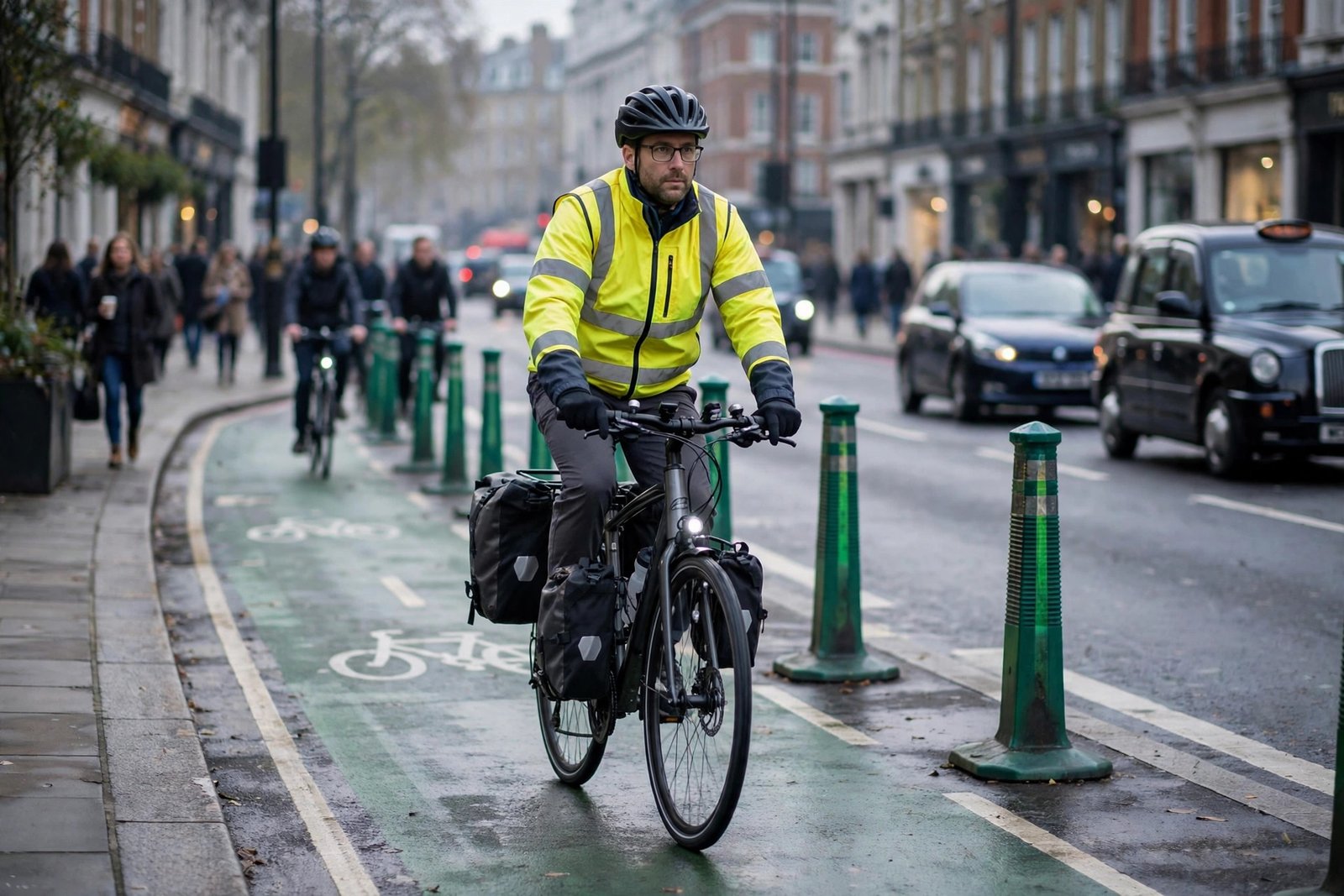
Britain’s roads are seeing a quiet revolution. Cycle commuting has grown steadily for a decade, supercharged by improved infrastructure in cities like London, Manchester and Bristol, and by the simple maths: cycling to work is faster than the bus in congested cities, vastly cheaper than driving or rail season tickets, and it builds your exercise into the day without finding extra time. But British roads can feel intimidating, and safety is the number one barrier for would-be cycle commuters. This guide covers everything: choosing the route, the bike, the kit, and the road skills that keep you safe.
Why cycle commuting is worth it
The case is compelling. Financially, a decent commuter bike pays for itself within months against rail or driving costs — and the government’s Cycle to Work scheme lets employees save 25–39% on bikes and equipment through salary sacrifice. For health, a 30-minute each-way commute delivers the recommended 150 minutes of weekly moderate exercise without a single gym visit. And in cities, cycling is often the fastest door-to-door option: no waiting for delayed trains, no circling for parking. As one of the cheapest ways to get around London — and most UK cities — it is hard to beat on pure economics.
Planning a safe route
Use cycling-specific mapping
Your driving or walking route is probably not your best cycling route. Apps like Komoot, CycleStreets and Google Maps’ cycling layer prioritise cycle lanes, quiet streets and canal towpaths over main roads. Spend a weekend test-riding your planned route when roads are quiet — you will discover the rat-runs, the hostile junctions and the blissful traffic-free cut-throughs that maps miss. A route 10% longer on quiet streets beats a direct route on a hostile A-road every time.
Know the infrastructure
British cycle infrastructure varies from excellent (segregated superhighways, traffic-free greenways) to paint-only lanes that vanish at junctions. Learn what is available on your corridor: segregated tracks, bus lanes (cycles permitted in most), quietways and canal towpaths. Towpaths deserve special mention — flat, car-free and often beautiful, though shared with pedestrians and occasionally muddy. Organisations like Cycling UK campaign for better infrastructure and offer route advice for members.
The bike: what you actually need
You do not need a £1,500 carbon racer. The ideal commuter is a reliable hybrid or flat-bar road bike (£300–£600 new, far less second-hand) with mudguards, a rack or panniers, and puncture-resistant tyres. Mudguards are non-negotiable in Britain — without them, every wet ride ends with a stripe up your back. Panniers beat backpacks for comfort and sweat reduction on rides over 20 minutes. Add two locks (a D-lock plus a cable for wheels), front and rear lights (legally required after dark), and a basic repair kit: spare tube, tyre levers, mini pump and a multitool. Learn to fix a puncture at home before you need to do it in the rain.
E-bikes: the game changer
Electric bikes have transformed cycle commuting for hilly routes, longer distances and less-fit riders. Legal UK e-bikes assist up to 15.5mph — enough to flatten hills and arrive sweat-free. They cost more (£1,000–£2,500), but the Cycle to Work scheme now covers e-bikes and many employers have raised their scheme limits accordingly. If distance or hills are your barrier, an e-bike removes them at a stroke.
Staying safe in British traffic
Ride assertively, not timidly
The counterintuitive truth of cycle safety: hugging the gutter is more dangerous than taking the lane. Riding 1–1.5m from the kerb keeps you out of the door zone, makes you visible, and discourages unsafe overtakes. At narrow points, junctions and roundabouts, take primary position — the centre of the lane — so drivers must overtake properly rather than squeezing past. This is the core teaching of Bikeability, the national cycle training programme, and free or subsidised adult Bikeability courses run in many areas — book one before your first commute.
The skills that matter
Master the lifesaver glance — a quick look over your shoulder before moving out, turning or changing position. Signal clearly and early. Make eye contact with drivers at junctions. Anticipate the classic hazards: car doors opening, vehicles turning left across you, pedestrians stepping out, and wet drain covers and leaves that treacherously reduce grip. In rain, brake earlier and avoid painted lines and metal covers when cornering. British Cycling’s commuting guides cover these techniques in depth.
Visibility and the Highway Code
Lights are legally required between sunset and sunrise — a bright front light and red rear light, plus reflectors. Hi-vis helps at dawn and dusk, though evidence suggests road positioning matters more than fluorescent clothing. Know the recent Highway Code hierarchy of road users, which gives cyclists explicit priority at junctions in many situations — and assume many drivers have not read it. Defensive riding means expecting mistakes, not trusting rules.
The practicalities: sweat, storage and weather
Arriving sweaty is the most cited practical barrier, and it is solvable. Ride at 70% effort rather than racing, use panniers instead of a backpack, and keep a wash kit and fresh shirt at work — many offices now have showers, and asking about them is increasingly normal. For bike storage, check whether your employer offers secure parking (they may be obliged to consider it); otherwise a quality D-lock through frame and rear wheel in a visible location deters most theft. Insure the bike on your home contents policy or specialist cycle insurance. As for weather: there is no bad weather, only inadequate mudguards and a missing waterproof. Committed all-weather commuters are a small, smug and entirely justified club.
If cycling does not suit your route, compare it honestly with the alternatives — our guide to using an Oyster card in London covers the public transport side for capital commuters.
Conclusion
Starting to cycle to work safely in Britain comes down to: a quiet, tested route; a reliable bike with mudguards, lights and locks; assertive road positioning learned through Bikeability training; and practical solutions for sweat and storage. The first fortnight is the hardest — after that, the commute becomes the best part of the working day. Cheaper than the train, faster than the bus, and 150 minutes of weekly exercise for free: the only real question is what took you so long.
Frequently Asked Questions
Is it safe to cycle to work in the UK?
Cycling carries some risk, but per-mile casualty rates are low and falling on improved infrastructure. Assertive road positioning, good lights, a well-planned route and Bikeability training reduce risk substantially — and the health benefits far outweigh the risks statistically.
How far is a reasonable cycle commute?
3–8 miles each way suits most riders on conventional bikes (20–45 minutes); e-bikes comfortably extend this to 10–15 miles. Beyond that, consider combining cycling with rail for part of the journey.
What bike is best for commuting in the UK?
A hybrid or flat-bar road bike (£300–£600) with mudguards, pannier rack, puncture-resistant tyres, lights and two locks. E-bikes are worth considering for hilly routes or longer distances.
How does the Cycle to Work scheme work?
Your employer buys the bike and equipment and you repay through salary sacrifice over 12 months, saving 25–39% through tax and National Insurance relief. Most employers now include e-bikes in their schemes.
What should I wear cycling to work?
Normal athletic clothing plus a waterproof layer; change at work. Padded shorts help on longer rides, and hi-vis plus lights are essential in low light. Keep shoes and a fresh shirt at the office.



Leave a Reply