What Is the Net Worth of Jay-Z? Age, Wife and Family Details
How Jay-Z Went from Brooklyn to The independent debut
Jay-Z is a rapper, songwriter, record executive and businessman whose career has moved, step by step, from independent hustle to the centre of the modern music industry. Born Shawn Corey Carter, he built his name first as a performer with a precise, conversational flow and a gift for turning street-level observation into chart records, and then as a founder who kept ownership of his work when many of his contemporaries did not. That second part of the story matters as much as the first. The records made him famous; the ownership, the label, the management company and the brand deals made him durable.
His rise was not instant. There was no major-label launch at the start, no ready-made machine behind the debut album. He and his partners sold music themselves, formed their own company and negotiated from a position they had created. When the breakthrough came in the late 1990s, it came on those terms, and the pattern repeated: a hit record would open a door, and a business structure would be built behind it.
Today his public position is unusual. He still records and performs selectively, he remains a reference point for younger artists, and his Roc Nation company works across music, sport and entertainment. He is also a family man whose private life, despite intense public interest, is guarded closely by both him and his wife.
Born in Brooklyn in 1969: the First Years
He was born on 4 December 1969 in Brooklyn, New York. His birthday falls in early December, and his age is given in full in the facts table below. He grew up in Brooklyn, in the Marcy Houses public housing development in Bedford-Stuyvesant, an upbringing he has returned to repeatedly in his lyrics as the grounding experience of his life. The neighbourhood, the buildings and the pressures around him in the 1970s and 1980s form the backdrop to much of his early writing, which is why his biography is so often told through place as much as through people.
His parents were Gloria Carter and Adnis Reeves. His father left the family when he was young, a loss he has spoken and written about with unusual directness, and his father died in 2003. The two reconciled shortly before that death, a meeting he later described as important in understanding his own life as a father. His mother, Gloria Carter, raised the family and remained a central figure in his life; she later became involved in charitable work connected to his foundation, and her own story was acknowledged publicly in his later music, most notably when he addressed her life openly on record with her participation.
As a boy he developed an intense interest in words and rhythm. Teachers noticed his reading ability early, and he filled notebooks with rhymes long before he had any route into a studio. Music offered both an escape and a discipline. By his teens he was known locally for his ability, taking the name that became Jay-Z and performing wherever an opportunity appeared. The years before fame were lean and, by his own account in interviews and lyrics, involved the street economy of his neighbourhood. He has never romanticised that period without also describing its cost, and the tension between where he started and where he arrived remains the central theme of his public biography.
Beyoncé and the Family at Home
His wife is Beyoncé. They married on 4 April 2008, in a private ceremony, after several years together that had begun in the early 2000s and included their work together on “’03 Bonnie & Clyde” and her single “Crazy in Love”. The marriage is one of the most closely watched in entertainment, yet the couple share comparatively little of its daily reality, and both have used their music, rather than interviews, to address its difficult periods as well as its strengths.
The couple have three children. Their daughter Blue Ivy Carter was born in 2012 and has grown up partly in public view, appearing on stage with her mother and contributing a spoken part to recordings as a small child. Their twins, Rumi Carter and Sir Carter, were born in June 2017. The twins are kept far more private than their elder sister, in line with the family’s general approach: the children appear when the parents choose, on their terms, and not otherwise.
Family in the wider sense starts, for him, with his parents, Gloria Carter and Adnis Reeves, whose story is told in the Born in Brooklyn in 1969: the First Years section. His mother’s later life, and his father’s absence and death in 2003, are recurring subjects in his writing, and they help explain the emphasis he places on presence and provision in his own household. Beyond those verified facts, he keeps the family’s arrangements out of public discussion, and this profile follows that record rather than speculation.
From The independent debut to Selective work and the wider company
1996 — The independent debut
His debut album, Reasonable Doubt, arrived in 1996 on Roc-A-Fella Records, the label he co-founded because established companies would not sign him on terms he would accept. Songs such as “Dead Presidents” and “Can’t Knock the Hustle” announced a writer interested in detail, patience and consequence. The album was respected immediately and has grown in standing ever since, frequently placed among the finest rap albums of its era. As a starting point it set the template: controlled delivery, vivid storytelling and a refusal to separate art from business.
1997 to 1999 — The breakthrough years
In My Lifetime, Vol. 1 followed in 1997, and Vol. 2… Hard Knock Life in 1998 carried him to a far larger audience. The title track of that album, built around a chorus drawn from the musical Annie, became one of the defining singles of the decade, and songs including “Can I Get A…” and “Money, Cash, Hoes” kept him at the centre of radio and club play. Vol. 3… Life and Times of S. Carter closed the decade in 1999, with “Big Pimpin’” among its best-known songs. In three years he had moved from independent seller to one of the biggest recording artists in the world.
2000 to 2003 — Dynasty, blueprint and a farewell that was not final
The Dynasty: Roc La Familia appeared in 2000, and The Blueprint in 2001 is widely regarded as a landmark album, with songs such as “Takeover”, “Izzo (H.O.V.A.)” and “Girls, Girls, Girls”. The Blueprint 2 followed in 2002, including “’03 Bonnie & Clyde”, his collaboration with Beyoncé, and “Excuse Me Miss”. In 2003 The Black Album was presented as a farewell to recording, and it played like a summation: “99 Problems”, “Encore”, “Dirt off Your Shoulder” and “Change Clothes” all became signature songs. A collaboration album with R. Kelly and a mash-up project with Linkin Park also belong to this period, showing how wide his working reach had become.
2006 to 2009 — Return and an anthem for a city
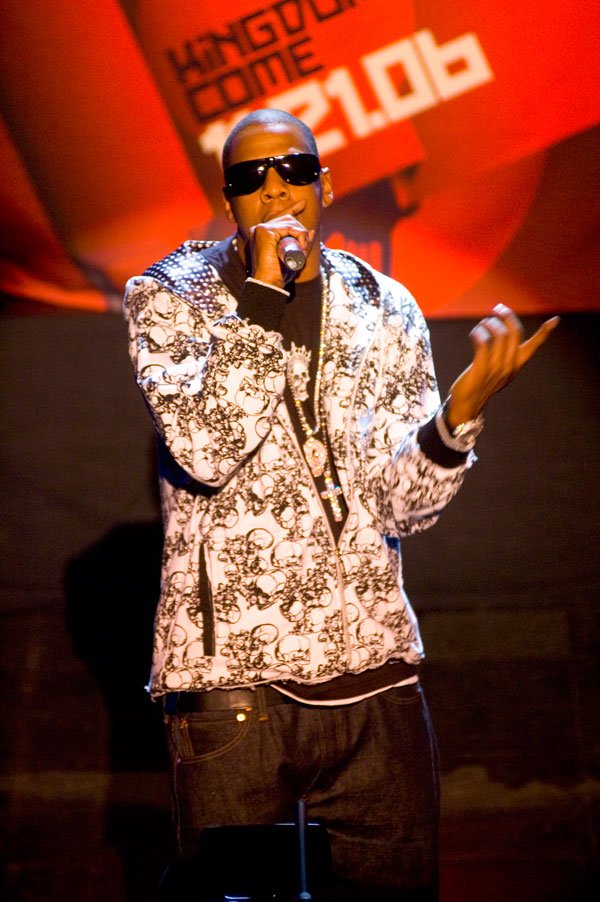
The retirement did not hold. Kingdom Come marked his return in 2006, American Gangster followed in 2007 as a companion in spirit to the film of the same period, and The Blueprint 3 in 2009 produced “Empire State of Mind”, his duet with Alicia Keys that became an anthem for New York and one of the biggest songs of his career. “Run This Town”, with Rihanna and Kanye West, and “D.O.A. (Death of Auto-Tune)” also came from that album. By the end of the decade his catalogue already spanned three distinct eras of popular music.
2011 to 2017 — Collaboration and a confessional peak
Watch the Throne, his joint album with Kanye West in 2011, included “Otis” and “Niggas in Paris” and toured stadiums on both sides of the Atlantic. Magna Carta… Holy Grail followed in 2013, with “Holy Grail” and “Tom Ford” among its key songs. Then, in 2017, 4:44 was received as one of the most personal records of his career, addressing marriage, fatherhood, his mother’s life and his own mistakes in plain language. The title track and “The Story of O.J.” drew particular attention, and the album showed a writer in his late forties still willing to revise his own public story in public.
2018 onwards — Selective work and the wider company
Everything Is Love, released in 2018 with Beyoncé as the Carters, included the single “Apeshit” and completed a period in which the couple’s separate and joint work spoke to each other across albums. Since then his recording has been selective — guest verses, occasional singles and performances at major moments rather than a steady album cycle. The wider work, however, has continued without pause: Roc Nation, founded in 2008, grew into a company covering artist management, a record label, sports representation and live entertainment, and his earlier roles included a period as president of Def Jam Recordings in the mid-2000s. His songwriting was recognised with induction into the Songwriters Hall of Fame, and his albums remain a fixed part of any serious account of modern popular music.
Jay-Z — Birth, Family and Career in Brief
| Jay-Z — Birth, Family and Career in Brief | Details |
|---|---|
| Born | 4 December 1969, Brooklyn, New York |
| Age | 56 (he turns 57 in December 2026) |
| Height | 6 ft 2 in (188 cm) |
| Weight | No reliable published figure exists |
| Wife | Beyoncé (married 4 April 2008) |
| Children | Blue Ivy Carter (born 2012); twins Rumi Carter and Sir Carter (born June 2017) |
| Parents | Gloria Carter and Adnis Reeves (died 2003) |
| No personal Instagram account in regular public use; he briefly joined in 2021 and deleted it | |
| Net Worth | $2.8 billion — Forbes (March 2026) and Celebrity Net Worth (2026) |
A note on the Instagram row, because it is the one entry in the table that records an absence rather than a presence: he has no personal Instagram account in regular public use. He briefly joined the platform in 2021 and deleted the account, and he has not maintained a regular public presence there since. Searches that appear to find him there are generally fan pages or pages belonging to his companies, not a personal account.
The Fortune Behind The independent debut
The headline figure is $2.8 billion. That is the estimate published by Forbes in its March 2026 celebrity billionaires coverage, and Celebrity Net Worth, in its 2026 figure, agrees at the same $2.8 billion. When two published sources of that kind land on the same number, the figure can be stated with more confidence than most celebrity estimates allow, and it is the figure used throughout this profile. An older Forbes figure of $2.5 billion, published in 2025, has been superseded by the March 2026 update and should not be quoted as current.
It is equally important to say what the figure is not. It is not a combined household total. Beyoncé is listed separately by Forbes at about $1 billion in her own right, so any presentation of a joint couple fortune as though it were his personal net worth would be wrong, and this profile does not do it. His $2.8 billion stands on its own, built from his own catalogue, companies and investments as the published sources assess them.
How was it built? The foundation is music owned rather than merely performed: masters and publishing interests in a catalogue that includes some of the most durable rap albums ever released, together with decades of touring income. Around that sit the companies. Roc-A-Fella began the pattern, Roc Nation extended it into management, sport and live entertainment, and his executive period at Def Jam placed him inside the major-label system he had once been locked out of. Brand, drinks and technology holdings have been reported as further components of the Forbes assessment. The picture the sources describe is consistent: earnings were repeatedly converted into ownership, and ownership compounded.
Joint Purchases With Beyoncé: the Malibu Estate and More
The homes listed here were joint purchases with Beyoncé, and they are the couple’s houses, not his alone; they are described that way deliberately. The largest is a Malibu estate designed by Tadao Ando, bought for about $200 million in cash in May 2023, which was California’s most expensive home sale at the time. Before that came a Bel-Air mansion bought for $88 million in 2017: about 30,000 square feet on two acres, with a 15-car garage and bulletproof windows, and a reported mortgage of $52.8 million taken against it. The couple also bought the Hamptons “Pond House” for $26 million in 2017, and his property history in New York reaches back to a Tribeca penthouse bought for $6.85 million in 2004. Taken together, the houses show spending at the very top of the residential market, in cash-heavy deals that only a fortune of this scale makes straightforward.
The Reported Fleet: a Maybach Exelero Among Them
There is no authoritative inventory of his cars, and any complete-looking list should be treated with caution. What can be said is what has been widely reported: a Maybach Exelero, valued at about $8 million, a Bugatti Veyron and a Maybach 62S are the cars most consistently attached to his name in reporting. In 2021 the couple were reported to have commissioned a Rolls-Royce Boat Tail at about $28 million; that commission is reported, not confirmed, and it is presented here on exactly that basis. A collection that includes even the confirmed reporting is exceptional, but the honest position is that no verified full inventory exists in public.
Why Jay-Z Still Leads the Conversation
Jay-Z’s story holds together because the same instinct runs through every part of it: keep the work, keep the rights, and build something that lasts longer than a hit. The songs and albums, from Reasonable Doubt to 4:44, would secure his reputation on their own. The companies and the catalogue ownership explain the fortune that Forbes and Celebrity Net Worth both now place at $2.8 billion, and the family life he protects so carefully explains the man behind both. Readers who want the companion account can follow Jay-Z’s net worth profile on Daily USA Post for its version of his story.
At 56, with a birthday each December still marked by fans as an event in itself, he occupies a position few recording artists have reached: elder statesman, active businessman and occasional performer, all at once. Whether the next chapter is another album, another company or simply more of the selective public presence of recent years, the structure he built means the work will keep paying, and being argued about, long after the chart weeks are forgotten.