
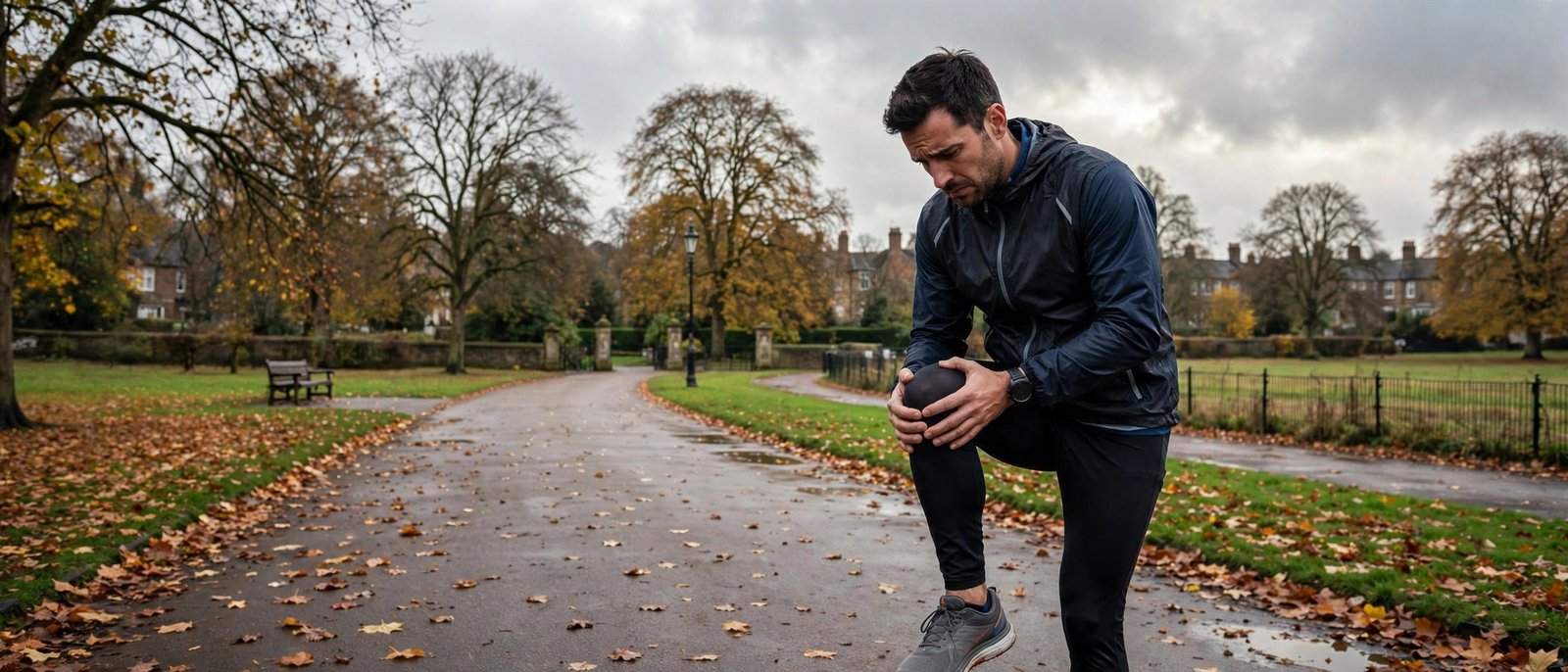
You finally started running — and now your knees ache with every step. It is the most common reason beginners quit, and the most misunderstood. Why do your knees hurt when you run in the UK? Usually it is not damage, arthritis, or “bad knees” — it is a handful of fixable training errors colliding with underprepared tissues. Here is how to diagnose your knee pain, fix the causes, and keep running safely.
First, Rule Out the Red Flags
Most running knee pain is benign and mechanical — but see a GP or physiotherapist promptly if you notice: swelling that does not settle within 48 hours, locking or giving way (the knee buckles or catches), pain at rest or at night, inability to bear weight, or pain after a specific twist or fall. These can indicate meniscus, ligament, or structural issues needing professional assessment. For the common dull ache around or behind the kneecap that appears during runs and fades after — “runner’s knee” (patellofemoral pain syndrome) — self-management usually works. The NHS guidance on knee pain helps distinguish routine from concerning symptoms. When in doubt, get checked — a single physio assessment (£40–£60 privately, or GP referral) costs less than months of anxious, painful running.
Cause 1: Too Much, Too Soon (The 80% Cause)
The overwhelming majority of beginner knee pain comes from training error: increasing distance, speed, or frequency faster than tissues adapt. Muscles adapt in weeks; tendons, cartilage, and bones need months. Classic triggers: jumping from 5K to 10K in a fortnight, adding hill sprints in week three, or running hard five days straight after months on the sofa. The fix is the 10% rule — increase weekly running time by no more than ~10% — plus hard-easy alternation (never two hard days back-to-back) and cutback weeks (every 3–4 weeks, drop volume ~30%). If pain appears, do not “run through it” — reduce volume by half for a week; if pain persists beyond two weeks of reduced load, see a physio. Starting from unfit with a run-walk plan is specifically designed to avoid this trap — impatience is the injury mechanism.
Cause 2: Weak Hips and Glutes (The Hidden Driver)
Here is the counterintuitive truth: most “knee” pain in runners originates at the hip. Weak glutes let the knee collapse inward with each stride (dynamic valgus), overloading the patellofemoral joint thousands of times per run. The fix is not knee exercises — it is hip strengthening. The evidence-based routine (2–3x/week, 15 minutes): clamshells, glute bridges, side-lying leg raises, single-leg squats, and monster walks with a resistance band. Studies show hip-strengthening programmes resolve runner’s knee as effectively as knee-focused ones — often faster. Add calf and quad strength (heel raises, step-ups, Spanish squats for patellar tendon issues) and single-leg balance work — running is a series of single-leg hops, so train it that way. Runners who strength-train consistently report dramatically less knee trouble; proper kit helps, but strong hips help more.
Cause 3: Shoes, Surfaces, and Form
Shoes: worn-out trainers (600–800km lifespan — check yours) lose cushioning and alter mechanics; and the wrong shoe type for your gait can overload knees. Get fitted at a running shop with gait analysis — it is free with purchase at most independents. Replace on mileage, not appearance. Surfaces: cambered pavements (roads slope for drainage) load one knee unevenly — vary routes, favour parks, trails, and running tracks. Concrete is harshest; grass and trails kindest (but watch ankles on uneven ground). Form: overstriding (landing with foot far ahead of body) spikes knee impact forces — cue “quick, light steps” and a slight forward lean from the ankles; increasing cadence ~5–10% (toward ~170–180 steps/min) reliably reduces knee loading in studies. None of these require a coach — a phone video of your stride from the side reveals overstriding instantly. Small form tweaks, big pain reduction.
The Recovery Toolkit: What Actually Helps
For mild, mechanical knee pain: relative rest (reduce, do not necessarily stop — complete rest weakens tissues further), ice after runs if sore (15 min), anti-inflammatories short-term if needed — understand painkiller safety before regular use, compression or a patellar strap for symptom relief during runs (aids, not cures), and cross-training (cycling, swimming maintain fitness while knees recover — low impact, high value). What does not help: expensive knee braces for mild pain, glucosamine (no meaningful evidence), and complete rest beyond a few days (tissues need graduated loading to heal stronger). Track pain on a 1–10 scale: pain ≤3/10 during a run that settles within 24 hours and does not worsen week-to-week is generally safe to train through with reduced volume; pain that escalates is a stop-and-assess signal. When self-management stalls after 2–3 weeks, find a chartered physiotherapist — early expert input shortens recovery dramatically.
Building Bulletproof Knees: The Long Game
Once acute pain settles, build resilience so it does not return. The forever routine (2x/week, 10 min): single-leg squats, glute bridges, calf raises, side planks — the minimum effective dose for runner’s knees. Gradual surface progression: introduce trails and hills slowly; varied terrain strengthens stabilisers roads never touch. Shoe rotation: alternating two pairs extends each pair’s life and varies loading patterns slightly — a small but real injury-reduction habit. Annual gait check: mechanics drift as fitness changes; a yearly running-shop assessment catches issues early. Respect the 10% rule forever — it applies at 50K/week as much as 5K/week; most experienced-runner injuries come from forgetting basics during exciting training blocks. Runners who treat knees as a maintenance project, not a warranty claim, run happily for decades. Your knees are not fragile — they are adaptable. Train them like it, patiently, and they will carry you further than you currently imagine.
Frequently Asked Questions
Will running ruin my knees long-term?
No — large studies find recreational runners have lower rates of knee osteoarthritis than sedentary people. Running strengthens the joint’s supporting structures when progressed sensibly; it is sudden overload, not running itself, that causes problems.
Should I run through knee pain?
Mild pain (≤3/10) that does not worsen during the run or linger beyond 24 hours is usually okay with reduced volume. Sharp pain, swelling, or pain that escalates means stop and get assessed.
Do I need new shoes if my knees hurt?
Check mileage first — dead shoes are a common culprit. If yours have 600km+ or are visibly worn unevenly, replace them with a gait-analysis fitting before assuming anything structural.
How long does runner’s knee take to heal?
With proper load management and hip strengthening, most cases improve within 4–8 weeks. Ignoring it and training through significant pain can extend recovery to months.
Are knee supports worth wearing?
Patellar straps and light sleeves can reduce symptoms during runs, which is useful for staying active during rehab. They do not fix the underlying cause — pair them with strengthening, not instead of it.
Knee pain when running is almost never a verdict on your joints — it is feedback on your training: too much too soon, weak hips, dead shoes, or harsh surfaces. Address the cause, strengthen the hips, progress patiently, and most knee pain resolves within weeks. The runners with healthy knees decades in are not the genetically gifted — they are the ones who learned to listen early. Your knees are talking. Now you know what they are saying.




Leave a Reply