
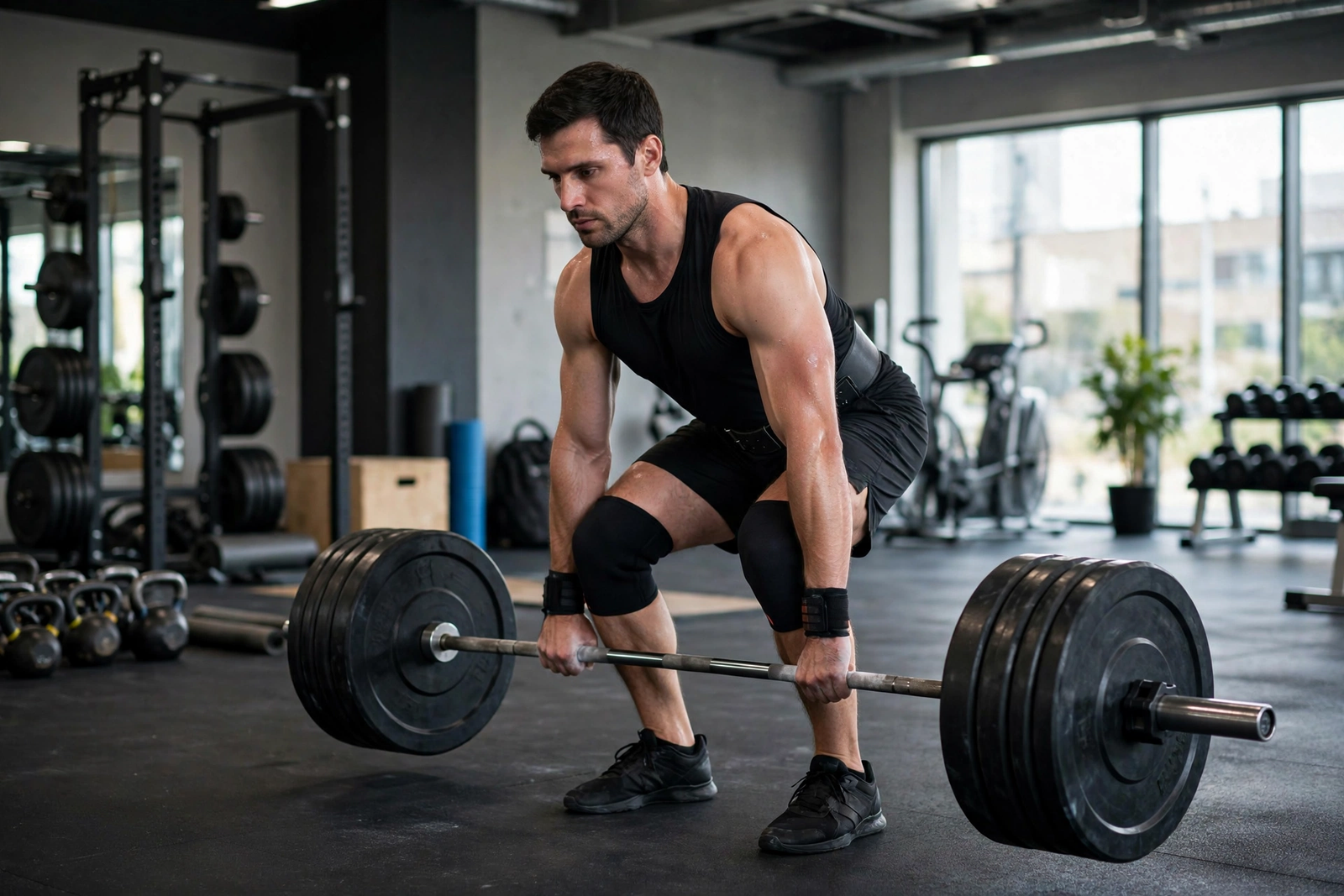
The deadlift is the king of lifts — and the most technical. If your numbers have stalled, the answer is rarely “just try harder.” It’s usually a fixable flaw in setup, a weak link in the chain, or a programming mistake. Here’s how to diagnose and fix all three.
Step 1: Fix Your Technique
Before adding a single kilo, video your deadlift from the side and check these points:
Setup
- Bar over mid-foot, shins touching the bar
- Hips higher than a squat but lower than a stiff-legged pull
- Chest up, back flat, lats engaged (“bend the bar around your shins”)
- Arms straight, grip just outside the knees
The pull
- Push the floor away — think leg press, not “lift the bar”
- Bar drags up the shins and thighs in a straight line
- Hips and shoulders rise together (no stripper-pole hips shooting up first)
- Lock out by driving hips forward, not leaning back
Film every heavy set. What you feel and what you’re actually doing are often very different — the camera doesn’t lie. If you’re unsure about bar basics, revisit how heavy different barbells are so your loading maths is right.
Step 2: Follow Progressive Overload
Your deadlift only grows if you systematically ask for more. Proven approaches:
- Linear progression (beginners): add 2.5 kg per session. Works until it doesn’t — usually 3–6 months.
- Weekly progression (intermediates): add 2.5 kg per week on a top set, with back-off volume.
- Block periodisation (advanced): 4–6 week blocks alternating volume accumulation and intensity peaks.
- The 5/3/1 method: monthly progression that’s sustainable for years — boring but brutally effective.
Track everything. A training log (paper or app) is non-negotiable — you can’t progress what you don’t measure.
Step 3: Strengthen Your Weak Points
Weak off the floor? → Build leg drive
- Deficit deadlifts (stand on a 2–5 cm platform)
- Paused deadlifts (pause 2 seconds just off the floor)
- Front squats for quad strength
Stuck at lockout? → Build posterior chain
- Romanian deadlifts for hamstrings and glutes
- Hip thrusts for glute power
- Block pulls / rack pulls from just below the knee
Bar drifting forward? → Build your back
- Barbell rows and Pendlay rows
- Lat pulldowns and weighted pull-ups
- Snatch-grip deadlifts for upper-back engagement
Grip failing? → Train it directly
- Double-overhand holds for time
- Farmer’s carries
- Consider hook grip or mixed grip for max attempts (learn hook grip early — it pays off)
Step 4: Programme It Intelligently
- Deadlift 1–2 times per week max. It’s the most fatiguing lift; more isn’t better.
- Separate heavy squats and deadlifts by at least 48–72 hours.
- Deload every 4–6 weeks: cut volume and intensity by 40–50% for a week. You’ll come back stronger.
- Sleep and eat: deadlifts don’t grow on 5 hours of sleep and a salad. Recovery is training.
The British Powerlifting website has excellent technical resources and can connect you with qualified coaches if you want expert eyes on your form.
Common Deadlift Mistakes
- Rounding the lower back under load — the fastest route to injury. Drop the weight and fix it.
- Bouncing reps off the floor — each rep should start from a dead stop (it’s called a deadlift).
- Over-gripping warm-ups — save your grip for work sets; use straps for high-rep back-off work if needed.
- Testing instead of training — maxing out weekly isn’t training, it’s ego. Build strength, then test it occasionally.
- Ignoring accessory work — the deadlift is built by rows, RDLs and core work as much as by deadlifting.
Sample 4-Week Deadlift Programme (Intermediate)
One heavy deadlift day per week, plus accessories:
- Day 1 – Deadlift focus: deadlift 5×3 at 80-85%, Romanian deadlift 3×8, barbell row 3×8, hanging leg raise 3×12.
- Day 2 (3-4 days later) – Posterior chain: hip thrust 4×8, good mornings 3×10, lat pulldown 3×10, farmer’s carry 3x40m.
- Progression: add 2.5 kg to the deadlift top sets each week for 3 weeks, then deload week 4 at 60%.
- Repeat: start the next block 2.5 kg heavier than the last.
This simple structure works for months. Complexity is the enemy of consistency – master the basics before experimenting with bands, chains or exotic variations.
Nutrition for Deadlift Progress
- Eat enough: building strength in a steep calorie deficit is brutally hard. A small surplus (200-300 calories) supports progress; recomposition works for beginners but stalls intermediates.
- Protein: 1.6-2.2g per kg bodyweight daily, spread across 3-4 meals.
- Carbs around training: a carb-rich meal 2-3 hours before deadlifting noticeably improves performance versus training fasted.
- Creatine monohydrate: 3-5g daily – the most evidence-backed supplement in existence, cheap as chips, and genuinely effective for strength.
- Sleep 7-9 hours: growth hormone peaks during deep sleep; short-changing it short-changes your deadlift.
Best Accessory Exercises for Deadlift (Ranked)
- Romanian deadlift: the single best deadlift builder – hammers hamstrings and glutes through the exact hip-hinge pattern.
- Barbell row: builds the upper back that keeps the bar close and the spine neutral.
- Hip thrust: isolates glute lockout power – the top half of the pull.
- Front squat: quad and core strength that transfers directly to breaking the floor.
- Farmer’s carry: grip, traps and core in one brutally simple movement.
- Good mornings: posterior chain strength with a lower-back emphasis – start light.
- Lat pulldown / pull-ups: lat engagement keeps the bar tracking against your body.
Programme 2-3 of these per week alongside your main deadlift day. Rotate emphasis every 4-6 weeks based on where you stall – the lift tells you what it needs if you listen.
Warm-Up Routine for Heavy Deadlifts
Never pull heavy cold. A proper warm-up takes 10–15 minutes:
- General (5 min): rowing machine, assault bike or brisk walk — raise your body temperature and get blood moving.
- Mobility (3–4 min): hip hinges with a dowel, cat-cow, 90/90 hip switches, thoracic rotations. Target the hips, hamstrings and upper back.
- Activation (2–3 min): glute bridges, bird-dogs, banded lateral walks — wake up the glutes so they actually fire during the pull.
- Ramp-up sets: empty bar × 10, 40% × 8, 60% × 5, 75% × 3, 85% × 1–2, then work sets. Rest 2–3 minutes between the heavier ramp sets.
Skip the static stretching before deadlifting — save it for afterwards. Dynamic movement prep is what heavy pulls need.
Deadlift Variations Worth Trying
- Romanian deadlift: the king of hamstring builders. Hinge with soft knees, lower to mid-shin, feel the stretch. Keep it lighter than your conventional pull.
- Sumo deadlift: wide stance, hands inside knees. Kinder on the lower back, brutal on the hips and quads. Give it a full 6–8 week block before judging.
- Trap-bar deadlift: the most beginner-friendly variation — the neutral handles and centred load make good form almost automatic.
- Snatch-grip deadlift: wide grip hammers the upper back and adds range of motion. Excellent accessory, humbling weights.
- Single-leg Romanian deadlift: balance, glute medius and hamstring strength in one move. Start bodyweight, add dumbbells slowly.
Rotate one or two variations into your programme as accessories — they fix weak points that conventional deadlifts alone can’t reach.
FAQs
How long does it take to improve your deadlift?
Beginners can add 5–10 kg per month for the first 6 months. Intermediates might manage 2.5–5 kg per month. Advanced lifters fight for kilos per year — that’s normal.
Should I deadlift every week?
Yes, but heavy only once a week for most people. A second lighter technique session is fine if recovery allows.
Why is my deadlift stuck but my squat going up?
Usually a technique issue (most commonly hips shooting up, turning it into a stiff-legged pull) or under-recovered posterior chain. Video your lifts and compare.
Is sumo or conventional better?
Whichever suits your leverages. Long arms and short torso favour conventional; short arms and long torso often suit sumo. Try both for 6–8 weeks each and compare. Both are legitimate — the NHS strength guidance supports either for general fitness.
Do I need a belt for deadlifts?
Not as a beginner — learn to brace properly first. A belt helps at heavier loads (roughly 1.5x bodyweight and beyond) by giving your core something to push against. It’s a tool, not a crutch.
How often should beginners deadlift?
Once a week is plenty for beginners – the movement is neurologically demanding and form practice matters more than frequency. Add a second light technique day only after 2-3 months of consistent training.
Should I use straps for deadlifts?
For heavy top sets where grip is the limiter, yes – straps let your back and legs get the stimulus they need. But always do warm-ups and at least one heavy set strapless so your grip keeps developing. In competition, straps are not allowed, so train accordingly.
Why do my shins bleed when I deadlift?
Because the bar drags up your shins — which is correct technique. Wear long socks or shin guards (deadlift socks cost under £10) and the problem disappears. Bloody shins are a badge of honour but an avoidable one.



Leave a Reply