
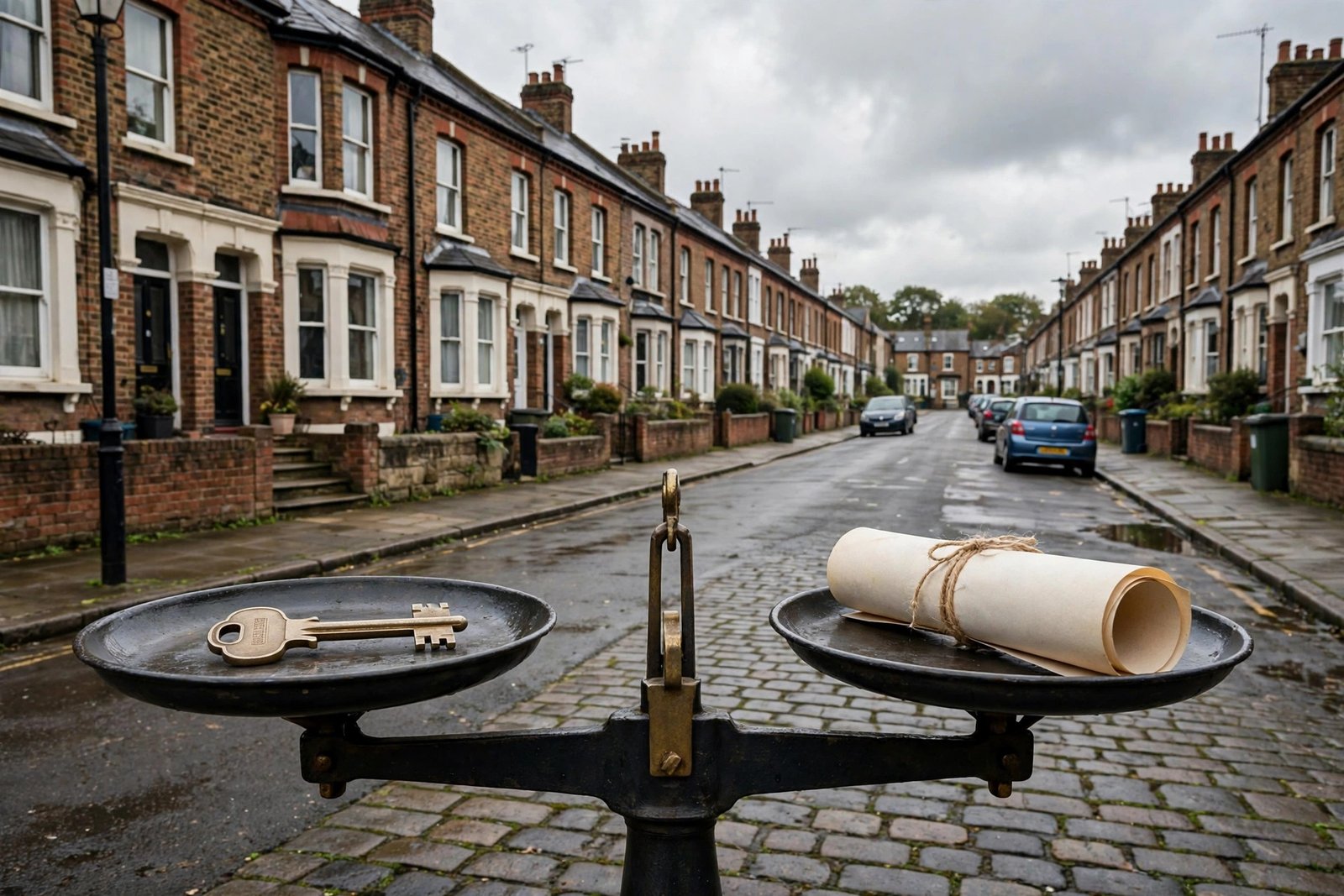
It is the defining financial debate of British adult life: is it better to rent or buy in Britain right now? House prices, mortgage rates, rents, and deposit requirements have all shifted dramatically in recent years, and the old certainties (“renting is throwing money away”) deserve a fresh look. The honest answer is genuinely personal — it depends on your timeline, location, deposit, and life plans. Here is how to decide with clear eyes and real maths.
The Case for Buying (When It Works)
Buying’s advantages are real. Forced savings: every mortgage payment builds equity — renters must be disciplined investors to match it, and most are not. Stability: no landlord selling up, no Section 21 no-fault eviction anxiety, freedom to decorate and keep pets. Inflation hedge: your mortgage payment is fixed (on a fixed rate) while rents rise — over 25 years, that difference is enormous. Leverage: a 10% deposit on a £250,000 home means 5% price growth earns you 50% on your deposit (leverage cuts both ways, mind). And with schemes like the Lifetime ISA (25% bonus up to £1,000/year) and First Homes discounts, first-time buyers get genuine help. The maths favours buying when: you will stay 5+ years, your mortgage payment is near rental cost, and you have a proper emergency fund beyond the deposit. Gov.uk’s home-buying guidance covers the schemes available.
The Case for Renting (Stronger Than You Think)
Renting is not failure — it is a legitimate financial strategy, especially now. Flexibility: jobs, relationships, and cities change; selling a house costs ~£5,000–£10,000 in fees and months of stress. True cost comparison: buying’s headline mortgage payment ignores stamp duty, maintenance (~1% of value/year), buildings insurance, and the opportunity cost of the deposit. A £25,000 deposit invested at 6% for a decade is ~£45,000 — buying forgoes that growth. Rate risk: at higher mortgage rates, renting can be outright cheaper monthly, letting you invest the difference. No negative equity risk: if prices fall 15%, renters shrug; recent buyers with 5% deposits face real pain. The break-even horizon — how long you must stay for buying to beat renting — stretches to 5–10 years in expensive areas once all costs are counted. If your life is mobile or uncertain, renting while investing the deposit difference is mathematically respectable. Weighing rent-vs-buy logic applies to business premises too.
Do the Maths: Your Personal Break-Even
Run your own numbers — averages lie. Buying costs: deposit + stamp duty (first-time buyers get relief up to thresholds — check current bands) + legal fees (£1,000–£2,000) + survey (£400–£1,500) + moving costs. Monthly buying: mortgage payment + buildings insurance + maintenance reserve + service charges (leasehold). Monthly renting: rent + (no maintenance, no stamp duty, deposit protected in a scheme). Compare over your realistic timeframe: if you might move in 3 years, buying’s upfront costs (£8,000–£15,000) rarely pay back. Online rent-vs-buy calculators help, but input your figures. Key variables: mortgage rate vs rent inflation, expected tenure, and house price growth (assume modest — 2–3% long-term real, not the boom years). Also stress-test: could you afford the mortgage at 2% higher rates? Lenders test this; you should too. MoneyHelper’s mortgage guidance walks through affordability honestly.
The 2026 Context: Rates, Prices, and Rents
The current environment reshuffles the deck. Mortgage rates, after their spike, have settled at levels well above the 1–2% era — meaning buying costs more monthly than a generation of buyers expected. House prices in many regions have plateaued or softened, improving affordability ratios but trapping some recent buyers. Rents, meanwhile, have risen relentlessly in most cities — strengthening the monthly case for buying where mortgage payments approach rents. Deposit requirements remain the towering barrier: the average first-time buyer deposit exceeds £50,000 nationally (far more in London). Government schemes help at the margins but do not transform the picture. Net: buying makes sense for the settled with deposits; renting makes sense for the mobile and the deposit-poor — and neither choice is morally superior. Watch official guidance on gov.uk for scheme changes, which move frequently.
How to Decide: A Framework
Answer these in order: 1. Will you stay 5+ years? No → rent. 2. Is your job and life stable? No → rent. 3. Do you have deposit + 3–6 month emergency fund + moving costs? No → keep renting and saving (do not raid the emergency fund for a deposit). 4. Is the monthly buying cost within ~10–15% of renting? If buying costs far more monthly, renting + investing the difference deserves serious consideration. 5. Could you handle rates 2–3% higher? No → wait or buy cheaper. 6. Do you want to own? Lifestyle preference is legitimate data — a home is also a home, not just an asset. If you buy: fix your rate for your likely tenure, keep the emergency fund intact, and secure your new home properly. If you rent: invest the difference deliberately — renting only builds wealth if the savings actually get invested, not spent.
Renting Well: How to Make Renting Build Wealth
If renting is your choice, rent well. Negotiate: rents are not fixed — longer tenancies, upfront payment, and off-peak timing (winter moves) all win discounts. Know your rights: deposits must sit in a protection scheme; repairs are the landlord’s duty — gov.uk’s renting guidance and Shelter’s advice pages are authoritative. Invest the difference: this is the non-negotiable part — if renting saves you £300/month versus buying, that £300 goes into your ISA automatically, not into lifestyle. Renters who invest the gap often outperform buyers on net wealth; renters who spend it do not. Keep mobility as an asset: use the flexibility — chase better jobs in other cities, the earnings premium of mobility is real. Renting is only “throwing money away” if the alternative — disciplined investing of the difference — does not happen. Make it happen automatically, and renting becomes a strategy, not a waiting room.
Frequently Asked Questions
Is renting really “throwing money away”?
No — rent buys shelter, flexibility, and freedom from maintenance, exactly as a mortgage payment’s interest portion buys nothing either. The real comparison is total cost of each option over your timeframe, not slogans.
How much deposit do I need to buy in the UK?
Minimum 5% for most first-time buyer mortgages (better rates at 10–15%+). On a £250,000 home, that is £12,500–£37,500 plus ~£5,000–£10,000 in fees and moving costs.
Should I wait for house prices to fall?
Timing the market is as unreliable in property as in shares. Buy when your life and finances are ready and the monthly maths works — not on predictions. Time in the market beats timing it, provided you stay long enough.
What help exists for first-time buyers?
Lifetime ISA (25% bonus), First Homes scheme discounts, shared ownership, and guarantor/family-assisted mortgages. Check current availability on gov.uk — schemes change frequently.
Can I get a mortgage if I am self-employed?
Yes — typically with 2–3 years of accounts/SA302s. Specialist brokers help. Getting your home set up well matters whichever route you choose.
Better to rent or buy in Britain right now? If you are settled, have the deposit plus a safety buffer, and the monthly maths is close — buying remains a superb long-term move. If you are mobile, uncertain, or deposit-poor — renting is not settling, it is strategy, provided you invest the difference. Run your numbers, be honest about your timeline, and ignore anyone selling certainty. The right answer is the one that fits your life, not the one that fits a slogan.




Leave a Reply