
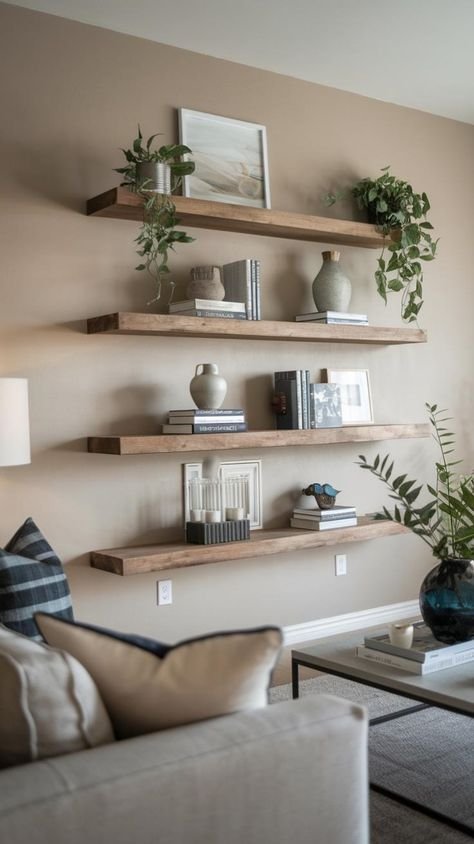
Hanging shelves on a plasterboard wall terrifies people unnecessarily. Yes, plasterboard is weaker than brick — but with the right fixings, a plasterboard wall will happily hold bookshelves, kitchen cabinets and wall-mounted TVs. The trick is matching the fixing to the load. Here’s how to hang shelves on a plasterboard wall so they stay up.
First: what kind of plasterboard wall do you have?
- Stud wall (plasterboard on timber studs): the most common. Fix into the studs where possible — that’s as strong as any wall. Use a stud finder or the tapping method to locate them.
- Dot-and-dab (plasterboard glued to blockwork): common in newer homes. There’s a gap between board and block — standard plasterboard fixings work, but longer screws reaching the blockwork behind are stronger.
- Plasterboard over old lath-and-plaster: trickier — fixings can crumble the old plaster. Go for studs or use wide-spreading anchors.
Knock on the wall: a hollow sound means stud wall; a solid-ish sound with slight hollowness suggests dot-and-dab. This determines your approach.
Choosing the right fixing (this is the whole game)
Light loads (up to 5kg per fixing): pictures, small shelves
Standard plasterboard plugs (the screw-in nylon or metal kind, £3 for 20) are fine. Drill a pilot hole, screw in the plug, then the screw. Simple and adequate for light duties.
Medium loads (5–15kg per fixing): bookshelves, kitchen shelves
Hollow wall anchors (umbrella/cavity fixings) or spring toggles. These spread the load across a wider area behind the board. Metal cavity anchors (£8 for 20) set with a setting tool give a very solid fixing — the “arms” clamp against the back of the board. This is the right choice for most shelving.
Heavy loads (15kg+ per fixing): wall cabinets, TVs, heavy bookcases
Find the studs. Seriously — for heavy loads, nothing beats screwing directly into timber. A 50mm wood screw into a stud holds 20–30kg easily. If you genuinely can’t hit a stud, use high-load spring toggles (the bar spreads load across a wide area) or proprietary heavy-duty fixings like GripIt (rated to 100kg+ per fixing in the right board). For wall-mounted TVs, a stud-mounted bracket is the only sensible option.
What NOT to use
- Ordinary wall plugs (the red/yellow/blue ones for masonry) — they have nothing to grip in hollow plasterboard and pull straight out under load.
- Nails — just no.
- Adhesive-only for anything with real weight — fine for a lightweight picture ledge, not for books.
How to hang shelves on a plasterboard wall: step by step
- Plan the load. Estimate the shelf’s total loaded weight (shelf + brackets + contents). Divide by the number of fixings. Choose fixings rated comfortably above that per-fixing load.
- Locate studs first. Even if you’re using cavity fixings, hitting a stud for at least some fixings dramatically increases strength. Mark stud centres with masking tape.
- Mark your bracket positions with a spirit level. For a shelf, mark both bracket positions and check level between them — a sloping shelf is immediately obvious.
- Drill pilot holes sized for your chosen fixing. For cavity anchors, the hole must be precise — too big and the anchor spins.
- Fit the fixings. For setting-tool cavity anchors: insert, squeeze the setting tool until the legs clamp behind the board, remove the screw, position the bracket, reinsert the screw. For spring toggles: fold the wings, push through, let them spring open behind the board, pull back gently while tightening.
- Mount the brackets, check level again, load the shelf gradually. Don’t pile 30kg of books on immediately — load it over a day and check the fixings are holding.
Special cases
- Floating shelves: the hidden bracket bar concentrates enormous leverage on the fixings — use the heaviest-duty fixings you can, ideally into studs. Floating shelves fail more often than bracketed ones because people underestimate the leverage.
- Kitchen wall cabinets: always into studs or with a continuous timber batten screwed to multiple studs, then cabinets hung on the batten. This is how professionals do it — the batten spreads the load across the whole wall.
- Tiled plasterboard (bathrooms): drill through tiles with a diamond bit (masking tape over the spot prevents slipping), then use appropriate cavity fixings. Go slow — cracked tiles are expensive.
- Very heavy items (radiators, boilers): these should be on studs or noggins, full stop. If the studs aren’t where you need them, open the wall and add noggins — it’s worth doing properly.
How much weight can plasterboard actually hold?
Standard 12.5mm plasterboard with good cavity fixings: 15–25kg per fixing for quality anchors, more for GripIt-style fixings. A shelf with 4 fixings into decent anchors theoretically holds 60–100kg — far more than the shelf itself can bear. The weak link is usually the shelf or bracket, not the wall. But these are ideal-condition figures; old, damp or damaged board holds far less. When in doubt, over-specify.
Essential tools
Beyond the basic home repair toolkit, shelf-hanging wants: a stud finder (£15–£25 — the electronic kind, not the magnetic gimmick), a good spirit level (600mm minimum), a setting tool if using cavity anchors (£10), and a sharp drill bit set. Total extra investment: under £40, and you’ll use them forever.
Shelf styling: making them look good
Once the shelves are solidly up, the styling matters. A few principles:
- Odd numbers — groups of 3 or 5 objects look better than pairs.
- Vary heights — tall vase, medium books, small object. The eye likes rhythm.
- Leave breathing room — a shelf crammed edge-to-edge looks cluttered; 30% empty space looks curated.
- Books both ways — some vertical, some stacked horizontally. Pure vertical rows look like a library; mixed looks like a home.
- One personal thing per shelf — a photo, a souvenir, something with a story. That’s what makes shelves feel like yours rather than a showroom.
And remember the weight: books are heavy (a metre of books weighs 15–25kg). Style with the load in mind — the beautiful shelf that collapses is nobody’s idea of good design.
For the manufacturer’s own fixing guidance, British Gypsum’s technical advice details which fixings suit their boards and the loads each type carries — the authoritative source for plasterboard fixings.
The takeaway
To hang shelves on a plasterboard wall: find the studs first and use them for heavy loads; use metal cavity anchors or spring toggles for medium loads in hollow sections; never use masonry plugs; and always over-specify your fixings. Done right, plasterboard shelving is rock solid — the failures you hear about are always wrong fixings, not weak walls.




Leave a Reply