
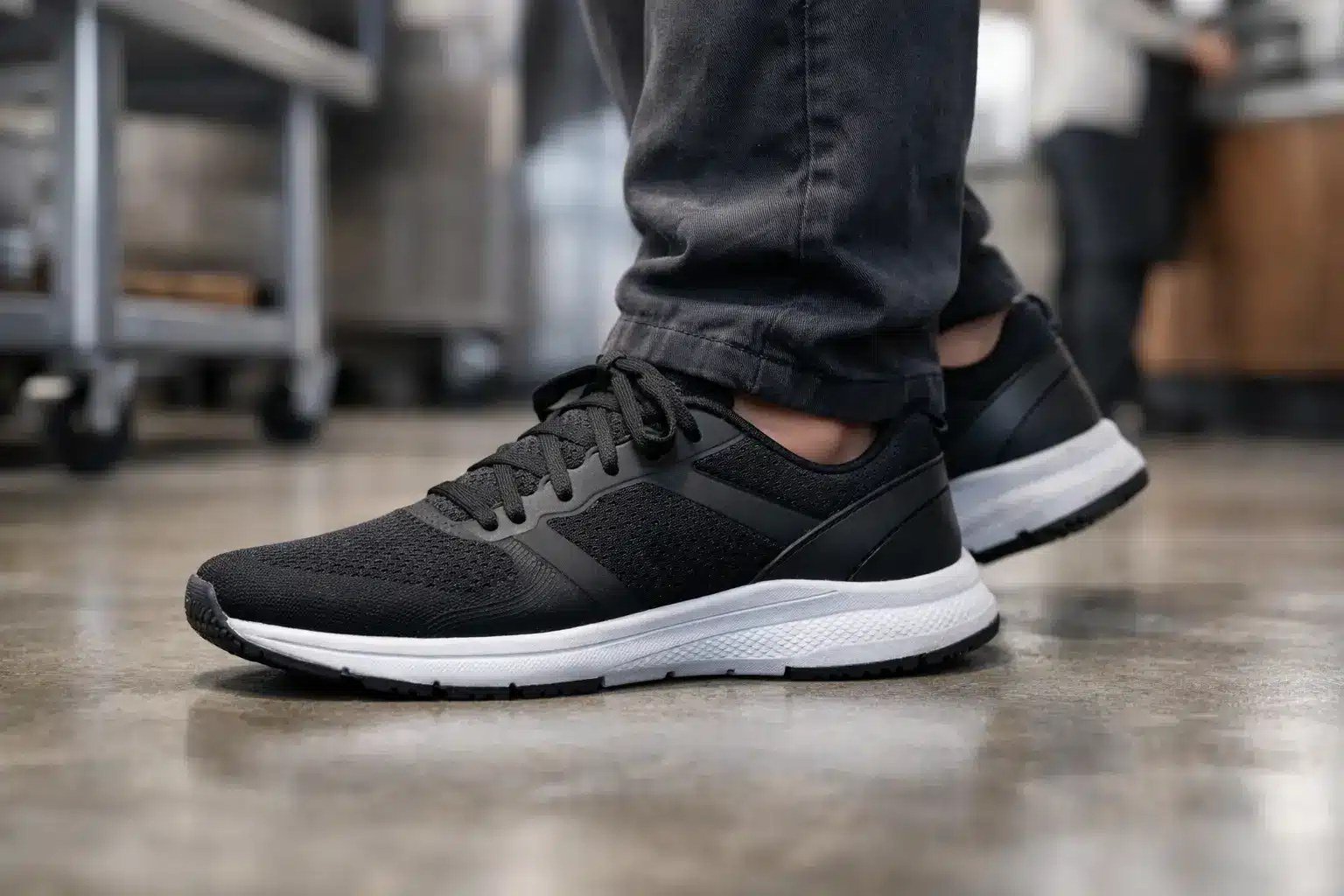
Nurses do 12-hour shifts. Retail workers stand for eight. Teachers rarely sit. If your job keeps you on your feet all day, your shoes aren’t a fashion choice — they’re occupational equipment. The wrong shoes mean aching feet by lunch, back pain by evening, and long-term problems. The best comfortable shoes for standing all day share specific features, and they’re not the ones most people guess. Here’s what actually matters. So, What are the best comfortable shoes for standing all day? Here’s what actually works.
What are the Best Comfortable Shoes for Standing All Day — What standing-all-day feet need
Standing is harder on feet than walking — walking distributes pressure dynamically, while standing loads the same spots continuously. The requirements:
- Cushioning. Shock absorption under the heel and forefoot — the impact zones. Memory foam, EVA, or air/gel systems. This is the single most noticeable comfort factor.
- Arch support. Supports the foot’s natural structure and prevents the collapse that causes plantar fasciitis (the heel pain that plagues standing workers). Flat, unsupportive shoes are the enemy — even fashionable ones.
- A proper fit. Feet swell through the day — shop for shoes in the afternoon, ensure thumb’s width at the toe, no pinching at the widest point. Too-small shoes cause more standing pain than any other factor.
- Light weight. Heavy shoes fatigue legs over hours. Every extra 100g per shoe is felt by hour six.
- Non-slip soles. For healthcare, hospitality and retail — safety as well as comfort. Oil- and water-resistant outsoles.
- Breathability. Hot, sweaty feet blister and ache. Ventilated uppers or moisture-wicking linings matter over long shifts.
The College of Podiatry (now the Royal College of Podiatry) provides authoritative guidance on foot health — worth consulting if you have persistent foot problems.
The best options by workplace
- Healthcare (nurses, carers, NHS staff): specialist nursing shoes or supportive trainers — clog-style (with back strap, not open-backed) or athletic shoes with arch support. Many NHS trusts have uniform policies; within them, prioritise cushioning and support. Brands like Skechers Work, Hoka and Brooks are ward favourites for good reason.
- Retail and hospitality: smart-casual requirements complicate things — but comfort insoles in smarter shoes, or supportive loafers/ballet flats with proper structure (not the flat-as-paper kind). Avoid: completely flat pumps, high heels for full shifts, and new shoes on a long day (break them in first).
- Teaching: the middle ground — smart enough for the classroom, comfortable for corridors and playground duty. Supportive loafers, low block heels, or smart trainers depending on school culture.
- Construction/trades: safety boots with comfort insoles — the safety spec is non-negotiable, but aftermarket insoles transform comfort. Replace insoles every 6 months.
The insole secret
Here’s what shoe salespeople won’t tell you: aftermarket insoles can transform almost any shoe. A £25 pair of supportive insoles (Superfeet, Scholl Work, or custom orthotics for problem feet) in decent shoes often outperforms expensive “comfort” shoes with poor stock insoles. If your workplace requires specific footwear that’s uncomfortable, insoles are the fix. Replace them every 6–12 months — they compress and stop working long before they look worn.
Daily foot care for standing workers
Shoes are half the equation. The other half:
- Rotate two pairs. Alternate daily — shoes need 24 hours to dry and recover their cushioning. Two pairs last more than twice as long as one.
- Compression socks. Reduce leg fatigue and swelling over long shifts — widely used by nurses and increasingly by retail workers. Genuinely effective, not just medical cosplay.
- Stretch calves and feet. Calf stretches against a wall, rolling a tennis ball under the foot — two minutes at break time prevents the Achilles and plantar fascia tightening that standing causes.
- Elevate after shifts. Feet up for 15 minutes after a long day — reduces swelling and speeds recovery.
- Replace on schedule. Cushioning degrades invisibly — most standing shoes need replacing every 6–12 months of daily use, however good they look outside.
What to avoid
Ballet flats with zero support (the worst common offender), high heels for full standing shifts (occasional is fine; eight hours is damage), completely flat flip-flops or sliders, shoes that are too small (“they’ll stretch” — they won’t, not enough), and wearing the same pair every single day. If you love your leather shoes, our leather care guide keeps them going — but even the best-maintained shoe needs the right structure for standing work.
When foot pain needs a podiatrist
Good shoes prevent most standing-related foot problems — but some need professional help. See a podiatrist (or your GP for referral) if:
Plantar fasciitis. Sharp heel pain, worst with the first steps in the morning, easing as you move — the classic standing-worker’s complaint. It’s inflammation of the tissue band under the foot, caused by the sustained loading standing creates. Early treatment (stretching, ice, supportive shoes, sometimes night splints or physiotherapy) resolves most cases in weeks to months. Ignored, it becomes chronic and much harder to treat. Don’t “push through” morning heel pain — it’s the early warning, not the main event.
Persistent forefoot pain (metatarsalgia). Burning or aching in the ball of the foot that doesn’t resolve with better shoes and rest. Can indicate Morton’s neuroma (a thickened nerve), stress fractures (in runners and very active workers), or biomechanical issues needing orthotics.
Bunions getting worse. The bony bump at the big-toe joint that progresses over time. Podiatrists can slow progression (footwear advice, orthotics, splints) and refer for surgery when conservative measures fail. Don’t wait until you can’t fit shoes — earlier intervention preserves options.
Recurring ingrown toenails or fungal infections. Beyond cosmetic — infected ingrown nails and persistent fungal infections need treatment, and standing workers (hot, sweaty feet in closed shoes all day) are prime candidates. A podiatrist sorts these quickly; DIY surgery on ingrown nails is a bad idea.
Numbness or tingling. Persistent numbness, burning or tingling in the feet — especially with diabetes — needs prompt assessment. Diabetic foot problems can escalate fast; the threshold for seeking help should be low.
What a podiatrist actually does. Beyond the problems above: gait analysis (how you walk and stand — the root cause of many issues), custom orthotics (moulded to your feet, far beyond over-the-counter insoles), nail and skin care, and footwear prescription. Many offer workplace assessments for standing workers. In the UK, podiatry is available on the NHS (via GP referral, though waits vary) and privately (£35–£60 per session). The Royal College of Podiatry has a find-a-podiatrist service.
Prevention beats treatment. Everything in this article’s shoe and foot-care sections is prevention — the workers who never need a podiatrist are usually the ones in good shoes with good insoles who stretch and rotate. But when prevention isn’t enough, professional help early beats suffering late. Foot pain that changes how you walk creates knee, hip and back problems upstream — the kinetic chain means feet are never “just feet.” And if back pain is part of your picture, our posture guide addresses the other end of the chain.
The practical takeaway
The best shoes for standing all day = cushioning + arch support + proper afternoon-tried fit + light weight + non-slip, breathable construction. Add quality insoles to transform decent shoes, rotate two pairs, wear compression socks, stretch at breaks, and replace every 6–12 months. Your feet carry you through every shift — equip them like it matters, because it does.




Leave a Reply